

01 • DASHBOARD
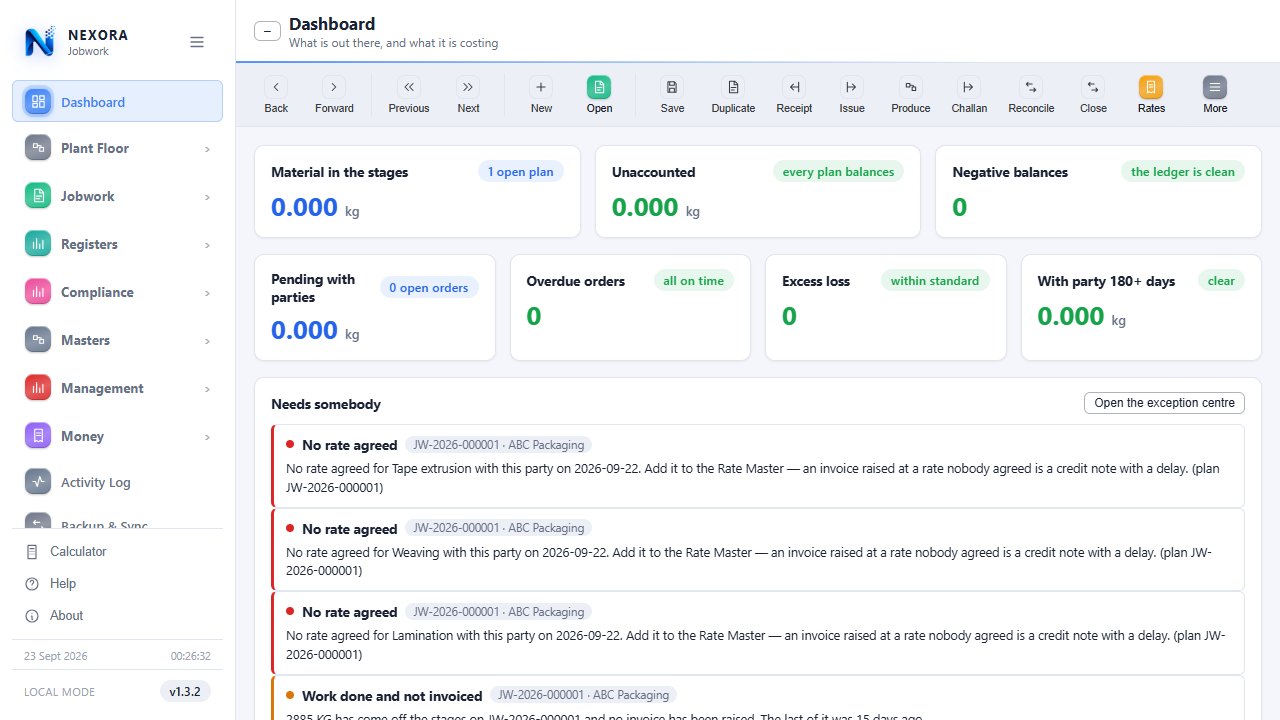
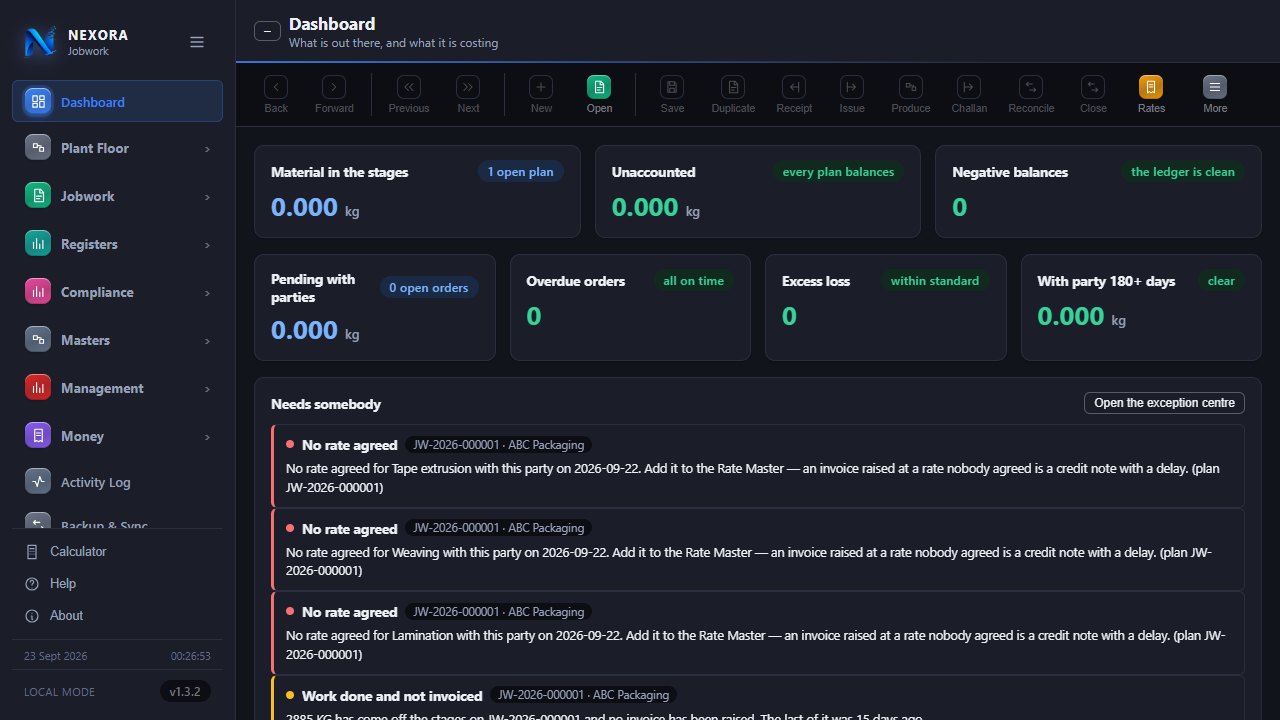
It opens on what needs somebody
Material standing in the stages, what is unaccounted, what is still with a job worker and how long it has been there. If the screen is empty there is nothing to do, which is the point.
Jobwork is somebody else's material in your plant, or your material in somebody else's. Nexora Jobwork answers both directions from one append-only ledger: what came in, what each stage did with it, what went back, what is still out — and the GST paperwork that has to go with it.
Every balance you see is added up from the documents that produced it, at the moment you look. That is why the statement you hand a customer cannot drift away from the challans they are holding.
Six documents from the customer's lorry to your invoice, and the reconciliation is folded out of them every time you look at it.
The paperwork that has to leave with the lorry, and the clock that starts when it does.
Not mock-ups. Every screen below is the software with a worked job loaded — a tonne of PP granule becoming laminated fabric, with the waste accounted for.
Material standing in the stages, what is unaccounted, what is still with a job worker and how long it has been there. If the screen is empty there is nothing to do, which is the point.
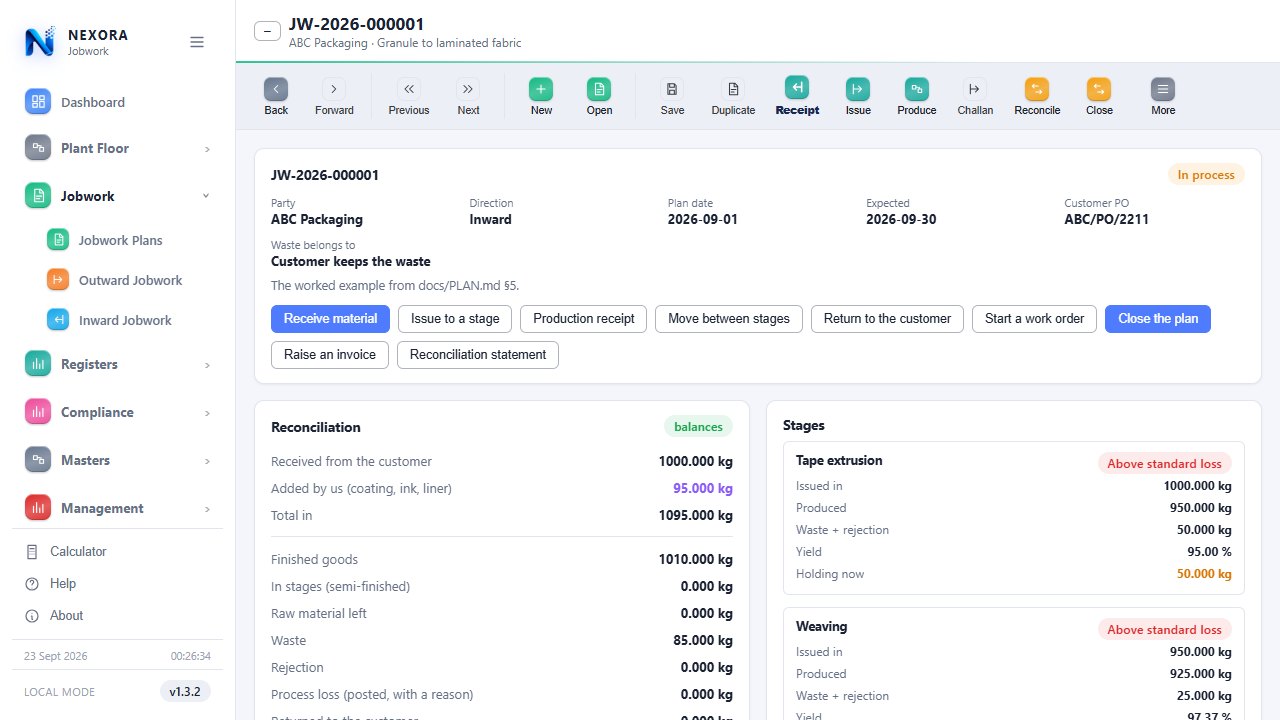
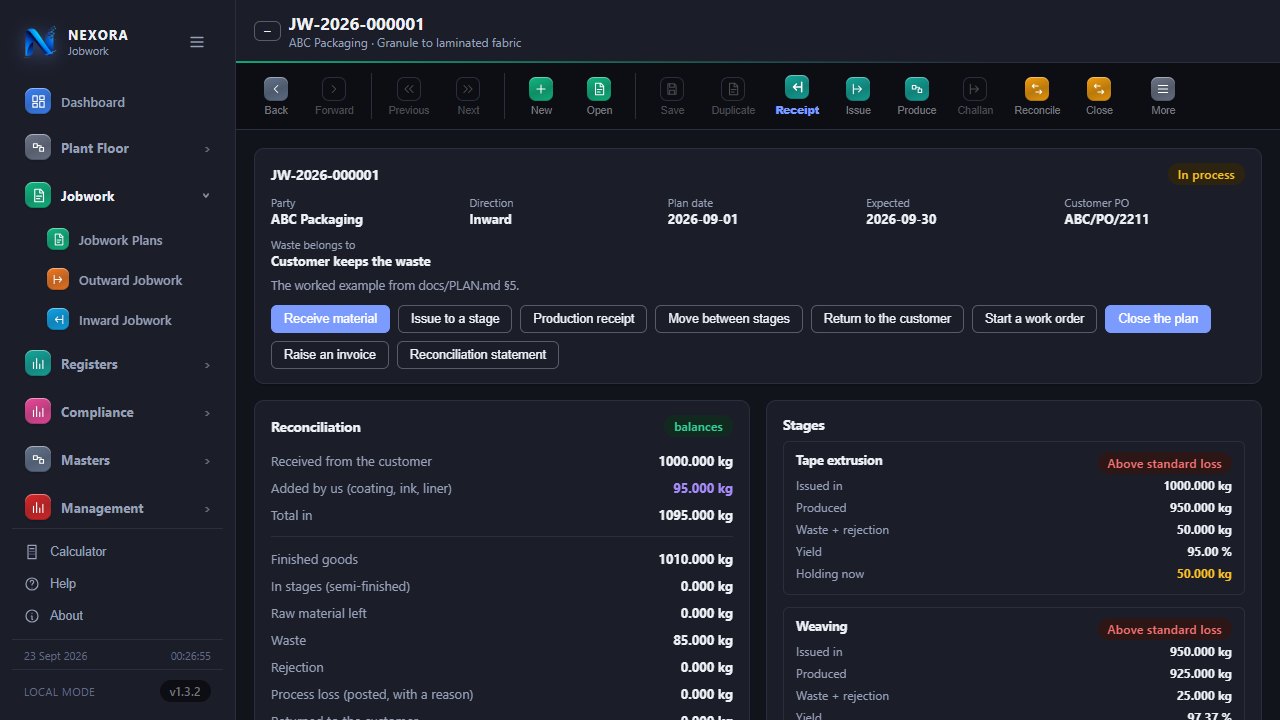
Received from the customer, added by you, finished goods, waste, rejection, process loss and what is still in the stages — with each stage's yield against its standard. All of it added up from the ledger when the screen is drawn.
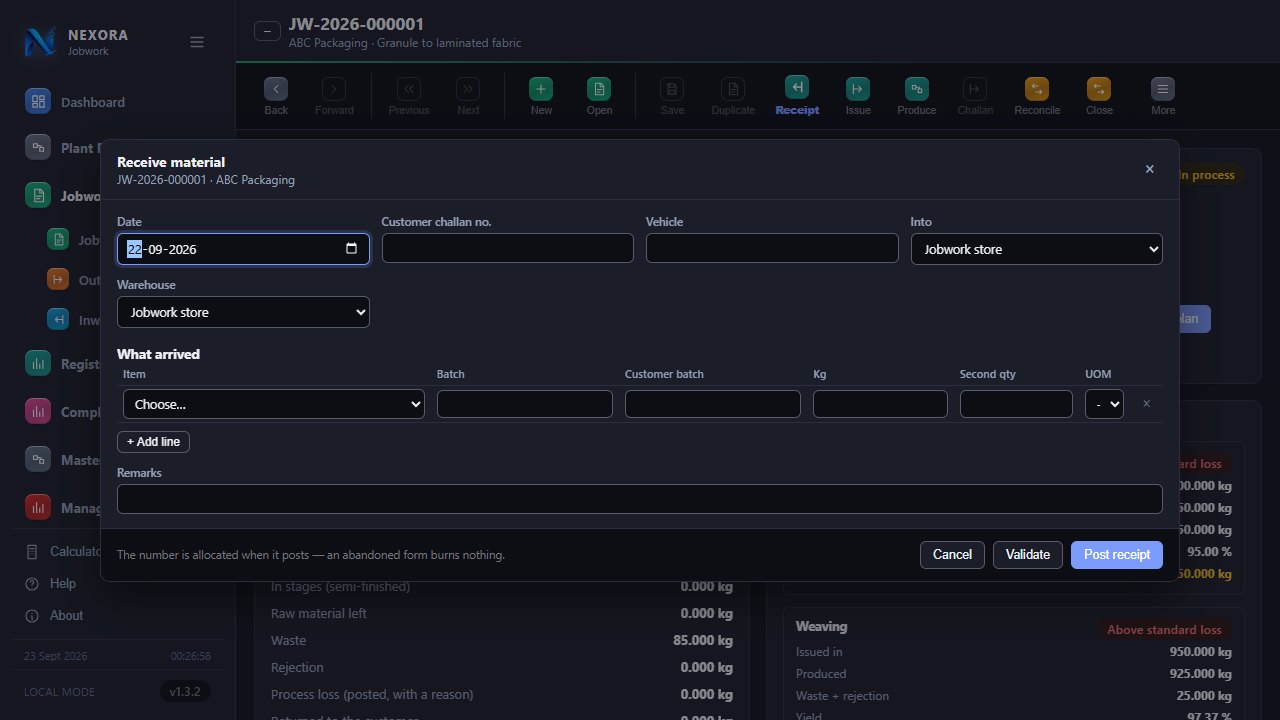
An abandoned form burns nothing, and two people saving in the same second cannot claim one number. A batch is required on every line, because a kilogram with no batch cannot be traced anywhere.
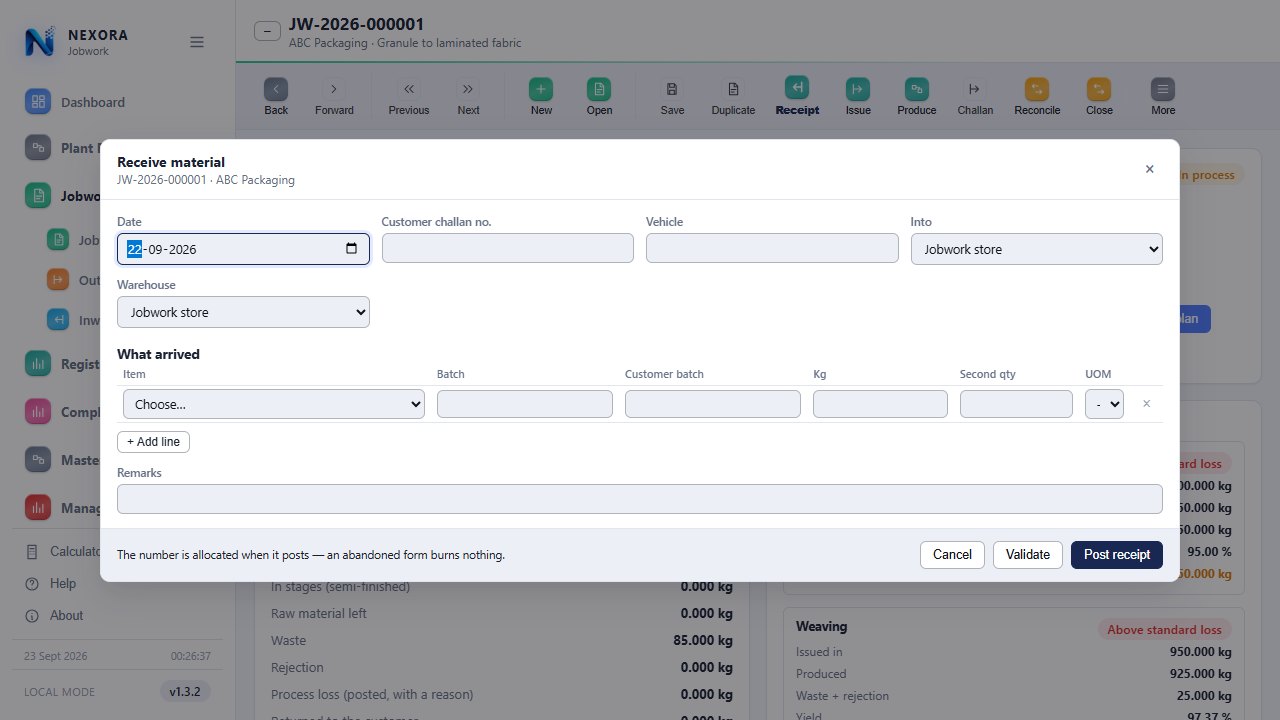
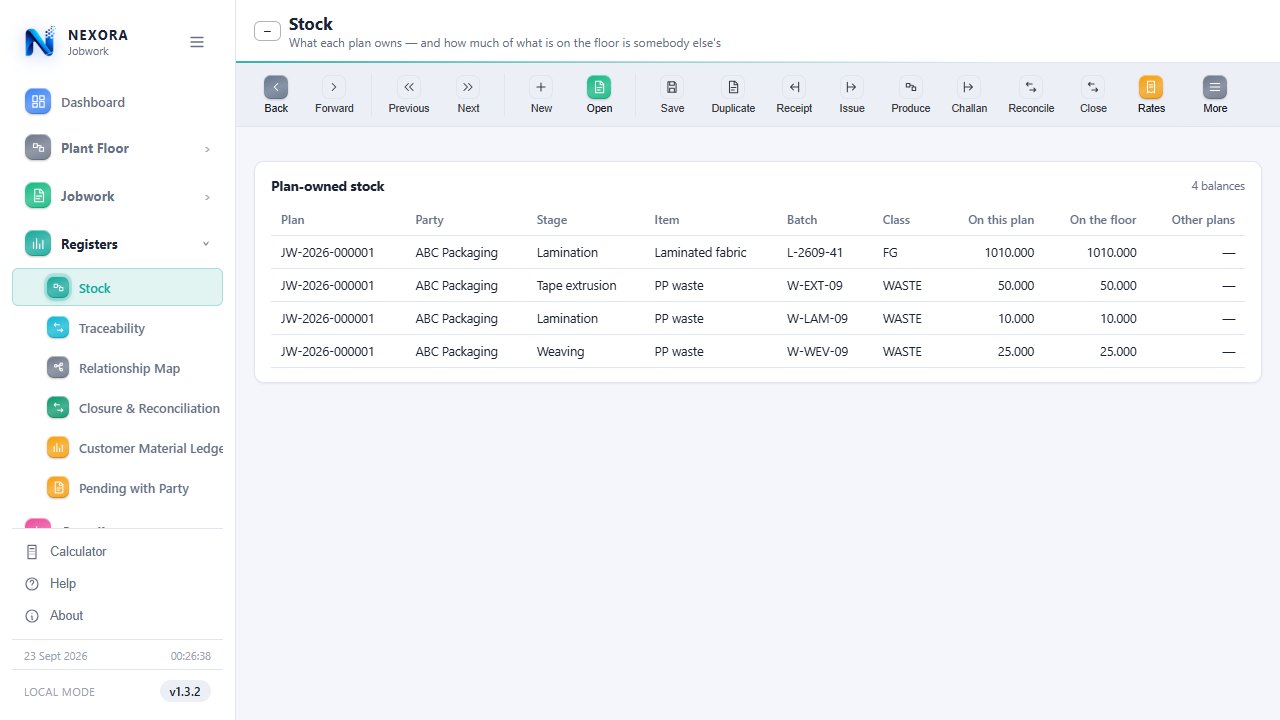
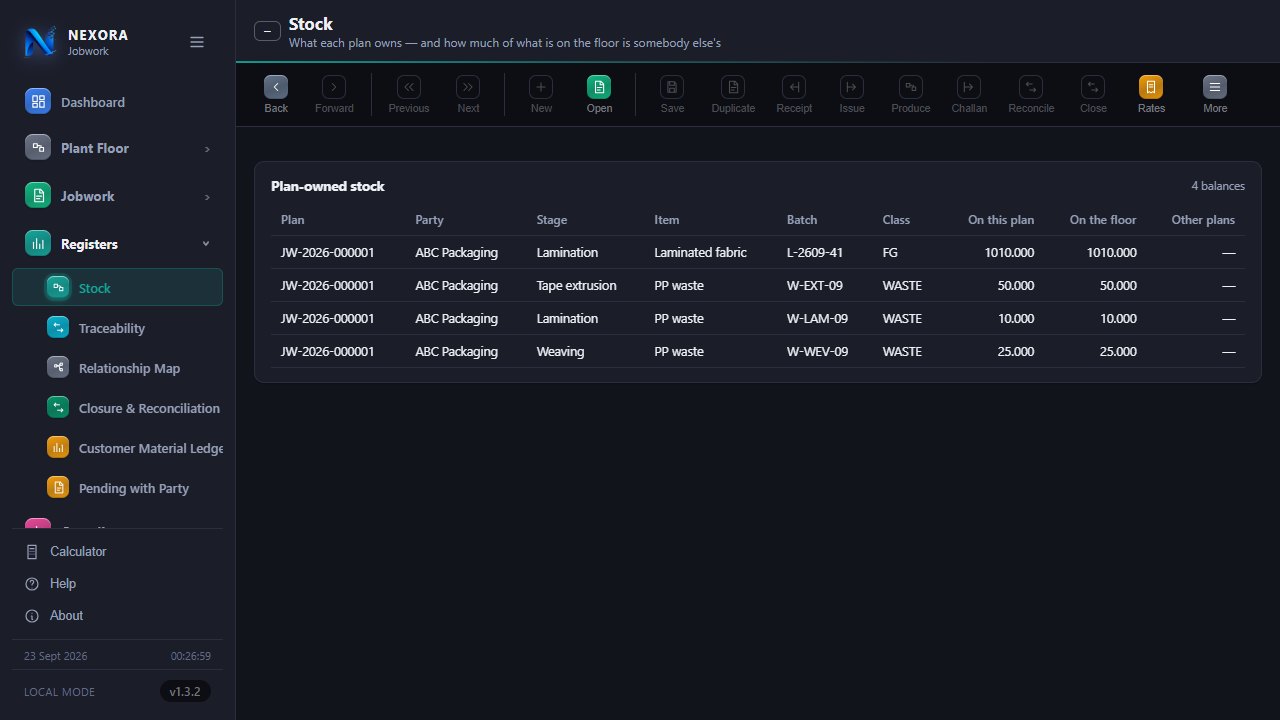
The customer's material is in your plant and is never your stock. It is reported separately for exactly that reason.
Section 143: one year for inputs, three years for capital goods, from the day the material went out. Past it, the material is deemed supplied on that date — so the warning starts at half the period, not on the last day.
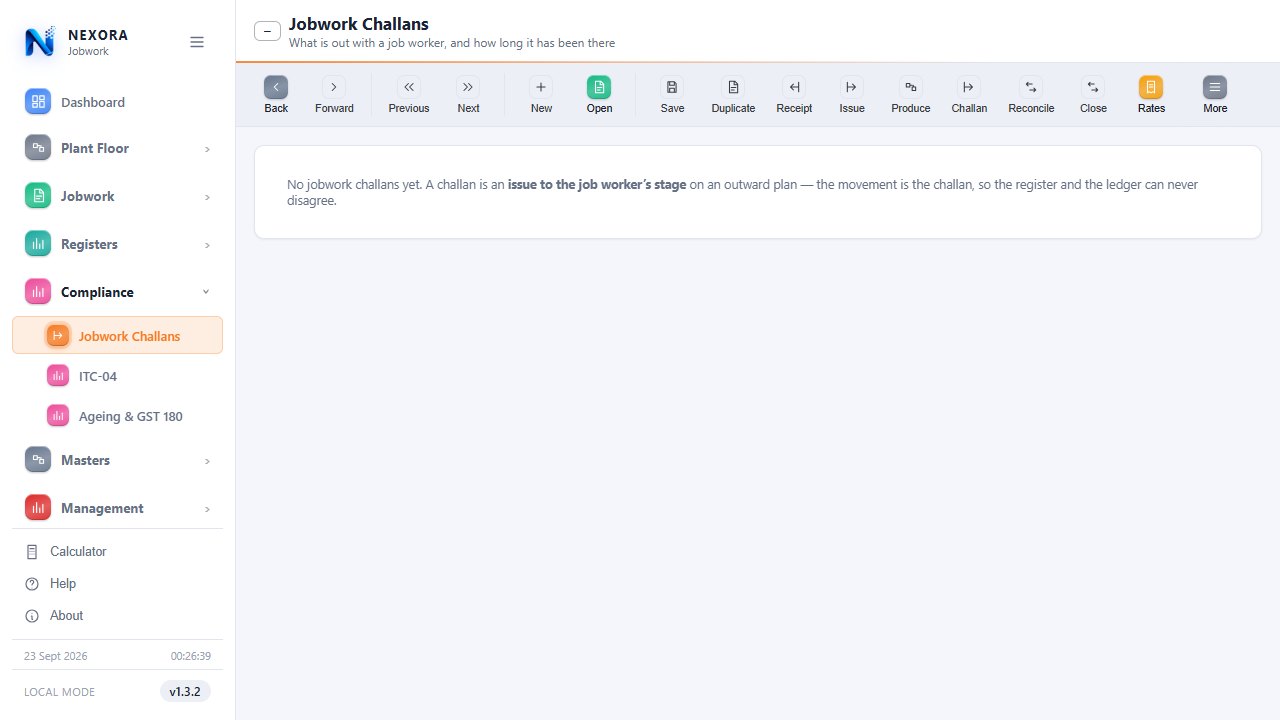
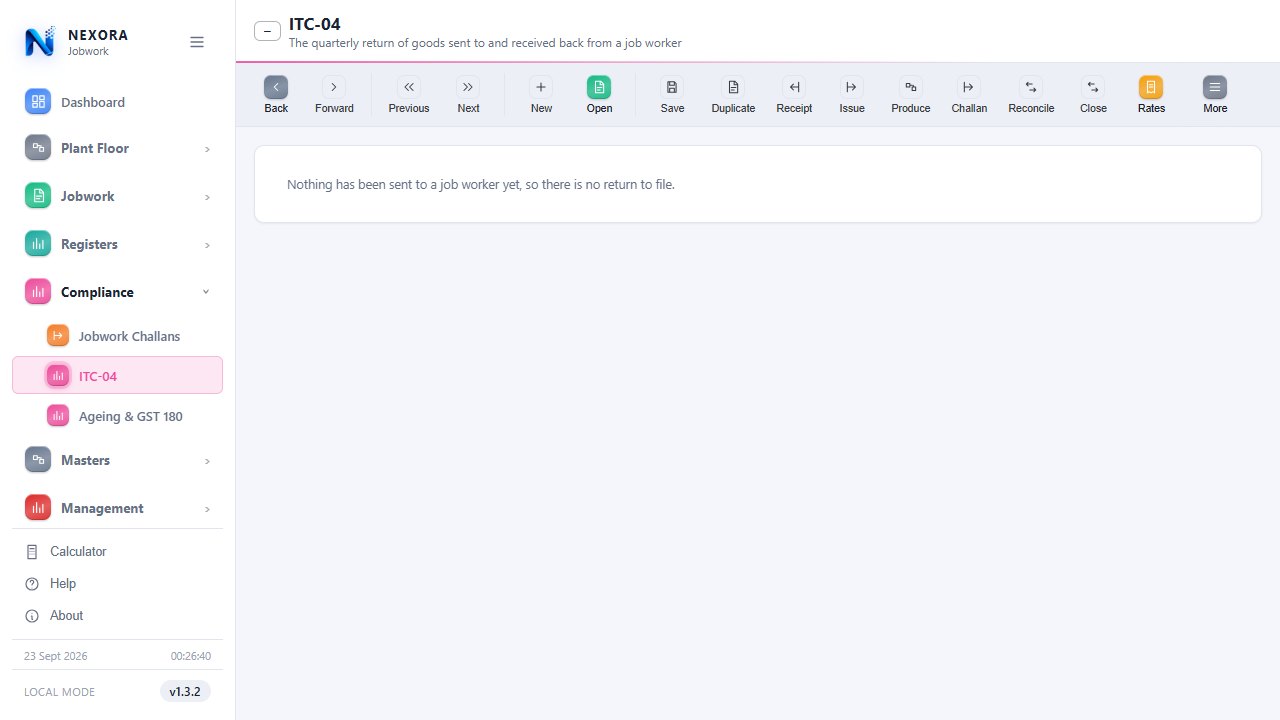
Table 4 (sent out) and Table 5A (received back) for the quarter, built from the same challan register the plant works from — not a separate calculation that can disagree with it.
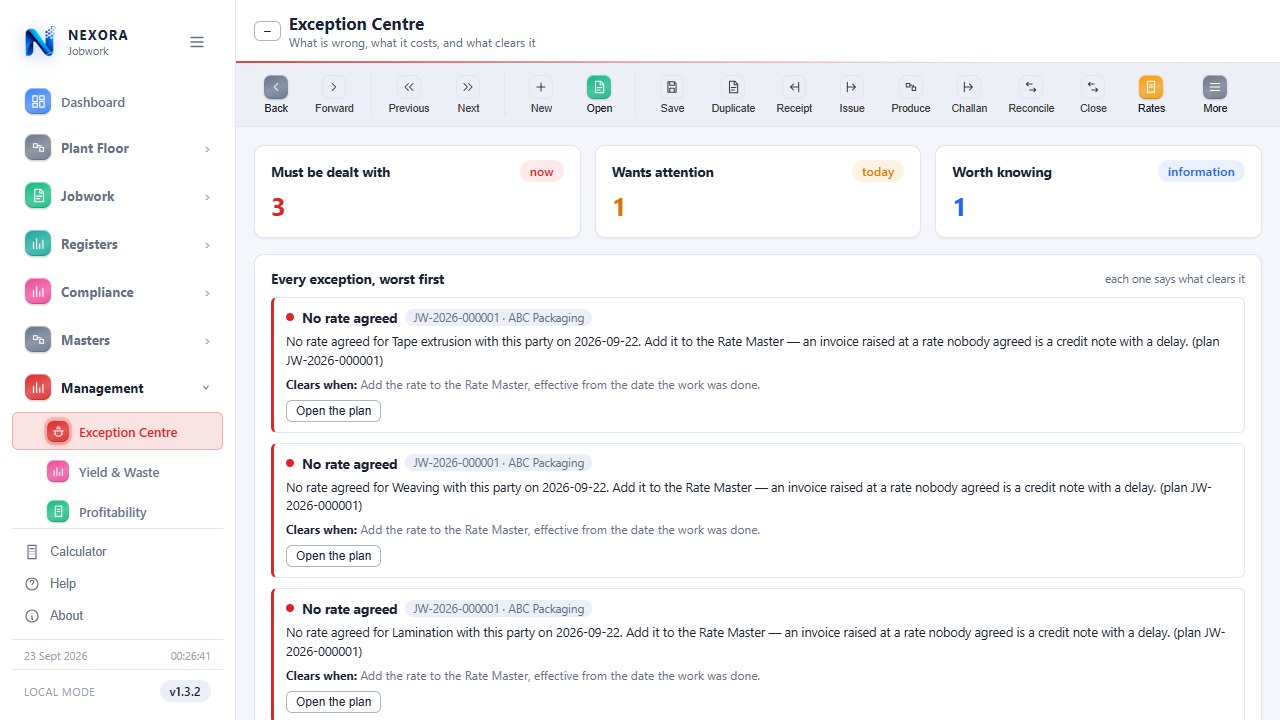
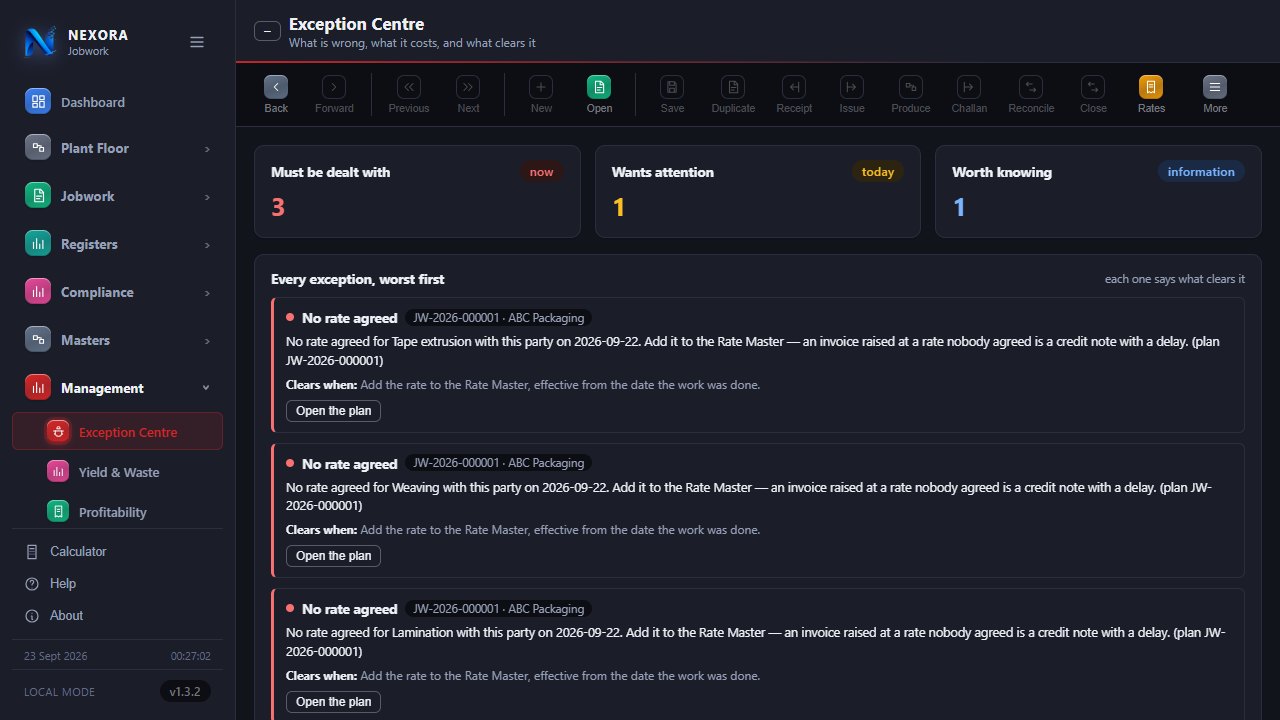
Negative stock, unaccounted material, a stage holding material, loss above standard, a plan that could be closed, work done and not invoiced, no rate agreed, a deadline approaching. Every card carries the numbers that raised it and the words that clear it — a list that only knows how to light up is a list nobody opens after a fortnight.
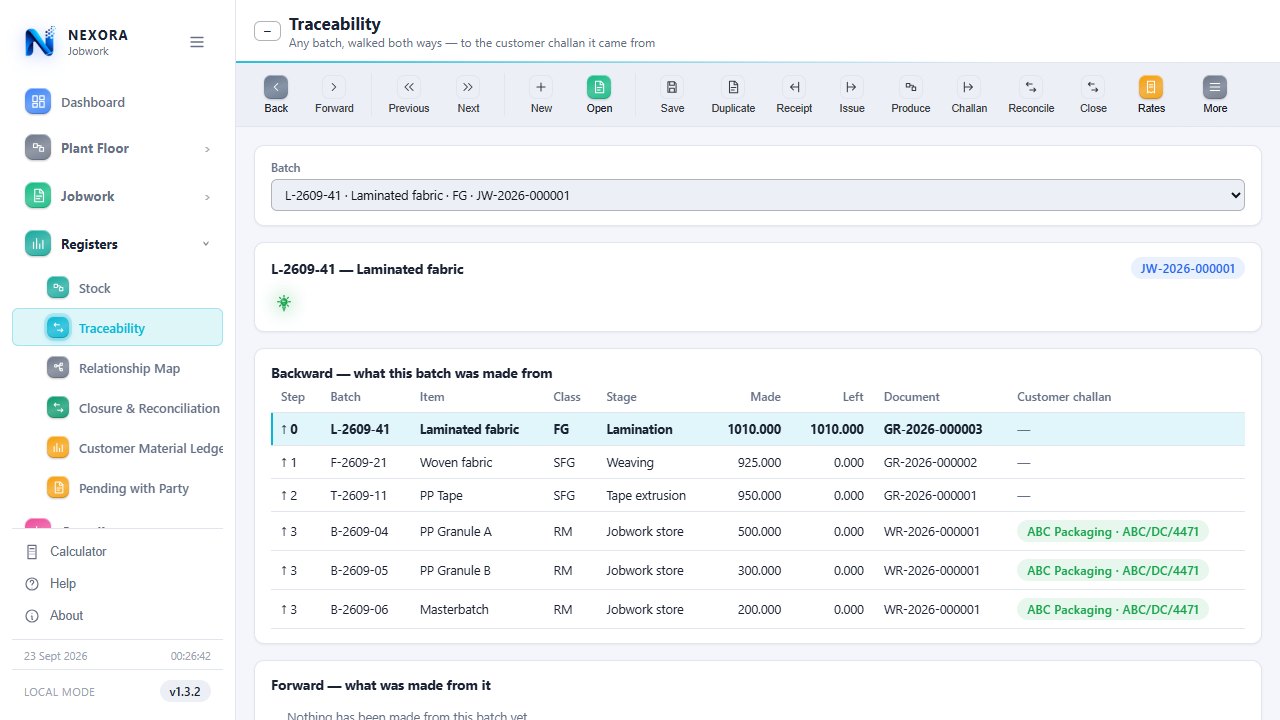
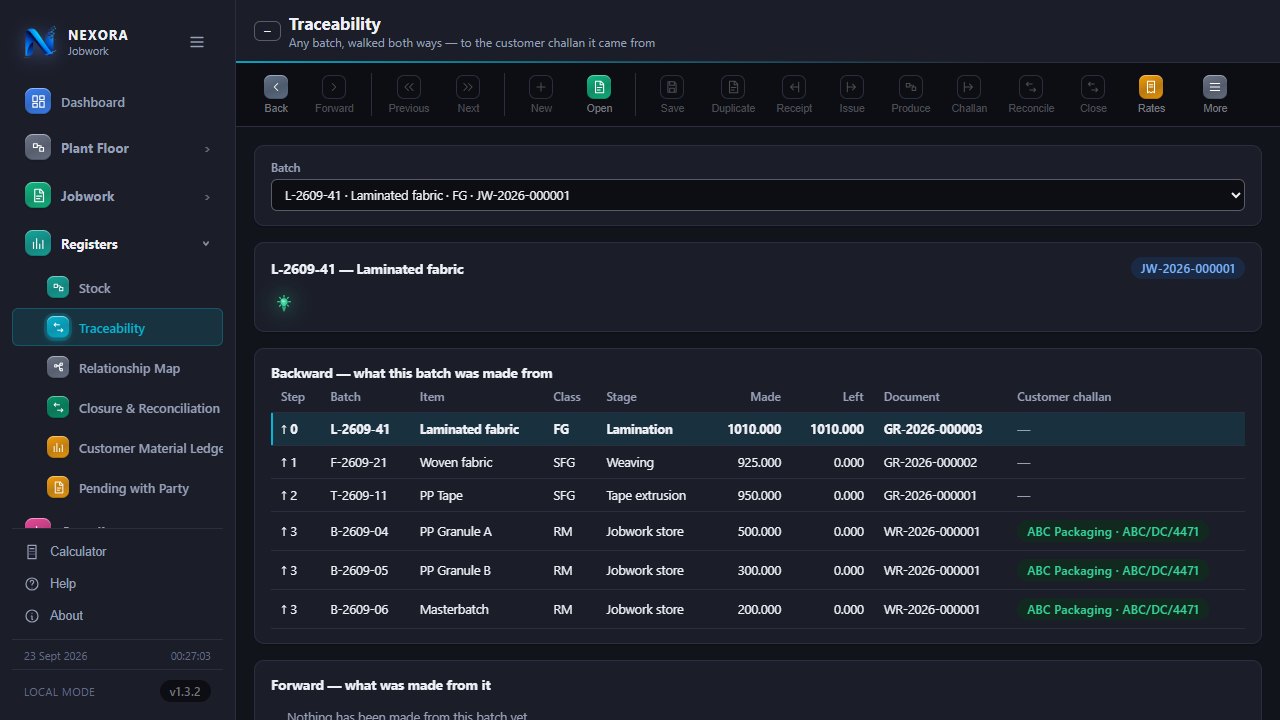
Where did this batch come from, and where did it go. Backwards to the customer challan it arrived on; forwards to the bags it became and the challan they left on.
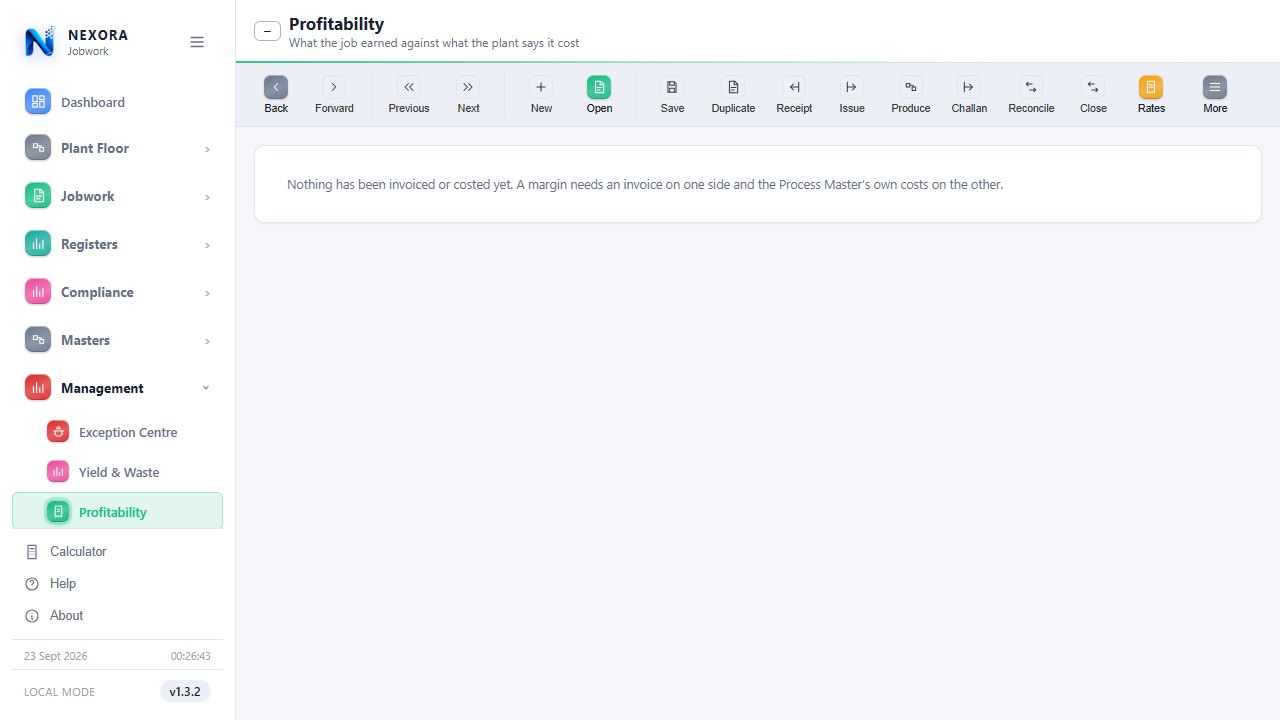
Revenue is what was invoiced; cost is the material you supplied plus each stage's setup and per-kilogram cost. Any figure the software does not have is named above the table and the margin is marked incomplete — a margin with a hole in it that looks like a margin is worse than none, because a plant would act on it.
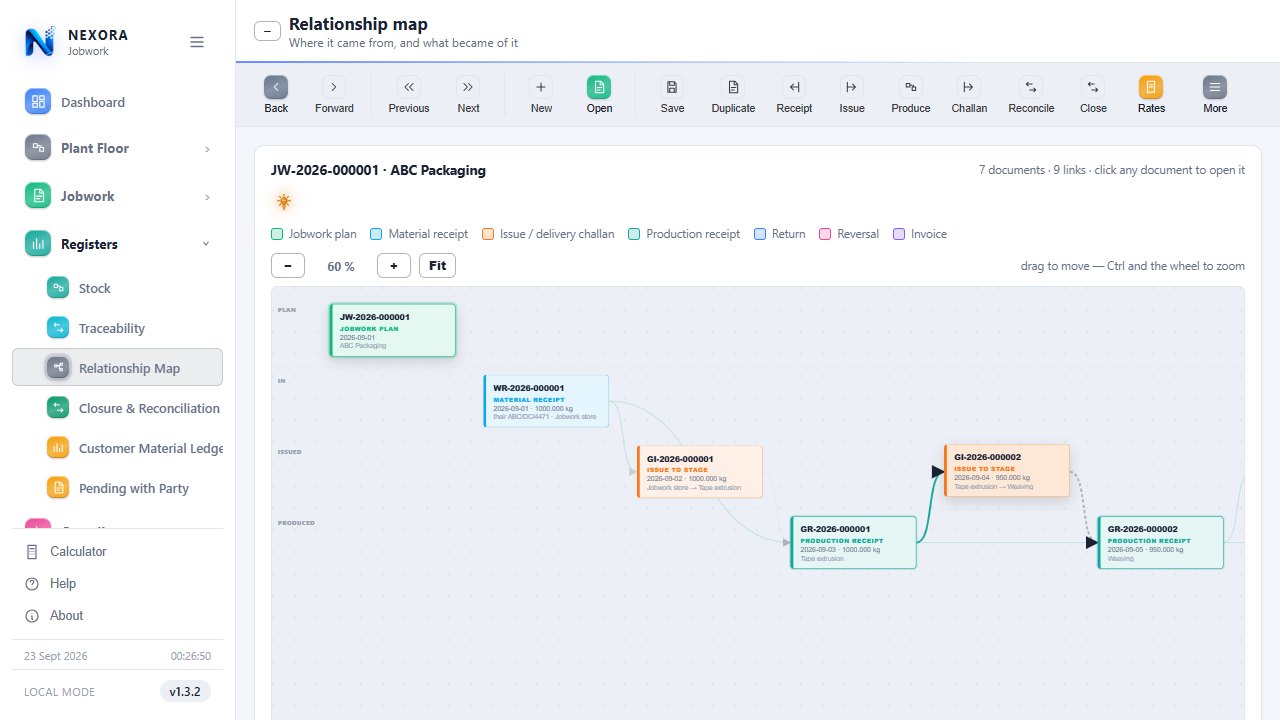
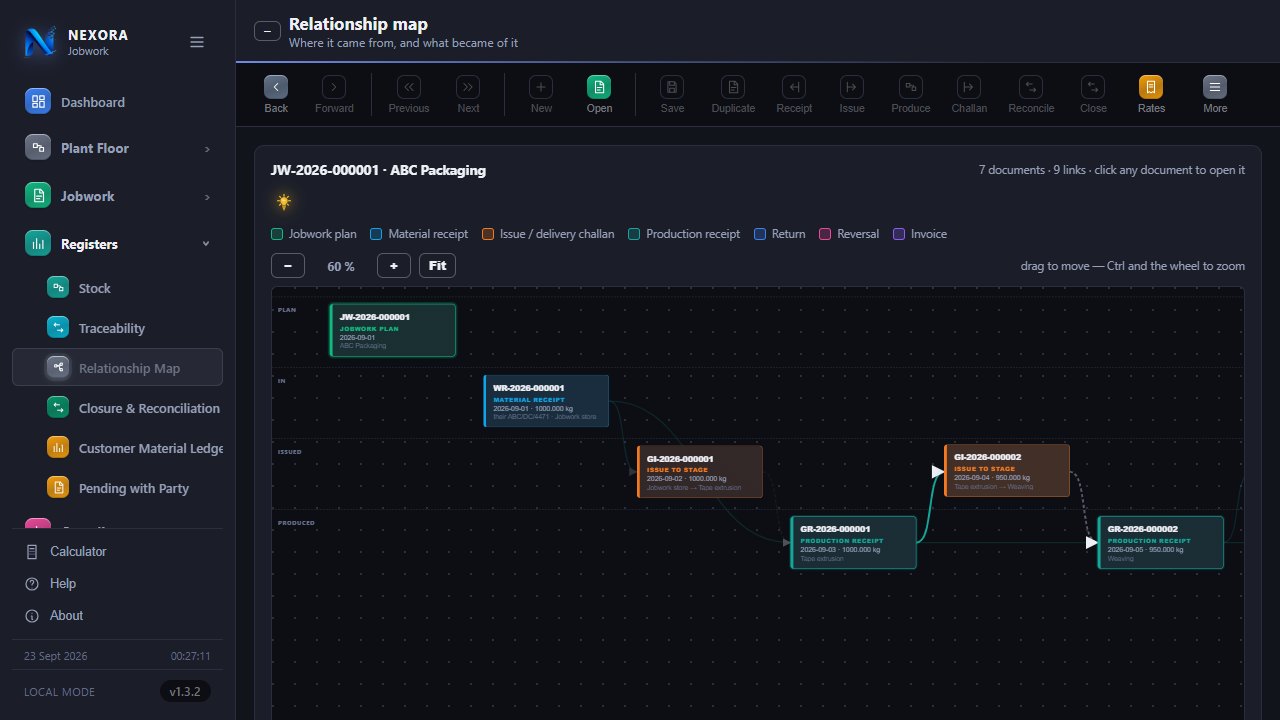
What came in, what each stage did with it, what went back out, and the invoice — with a line for every link and a sentence saying what each line means. Underneath, the two chains: where this came from, and what became of it, step by step.
Most software draws a map like this by remembering that somebody copied one document from another. This one is drawn from the batch chain: every output batch records the batches it was made from, so a line means this material became that. Colour says what each document is, dragging moves the map and Ctrl with the wheel zooms it.
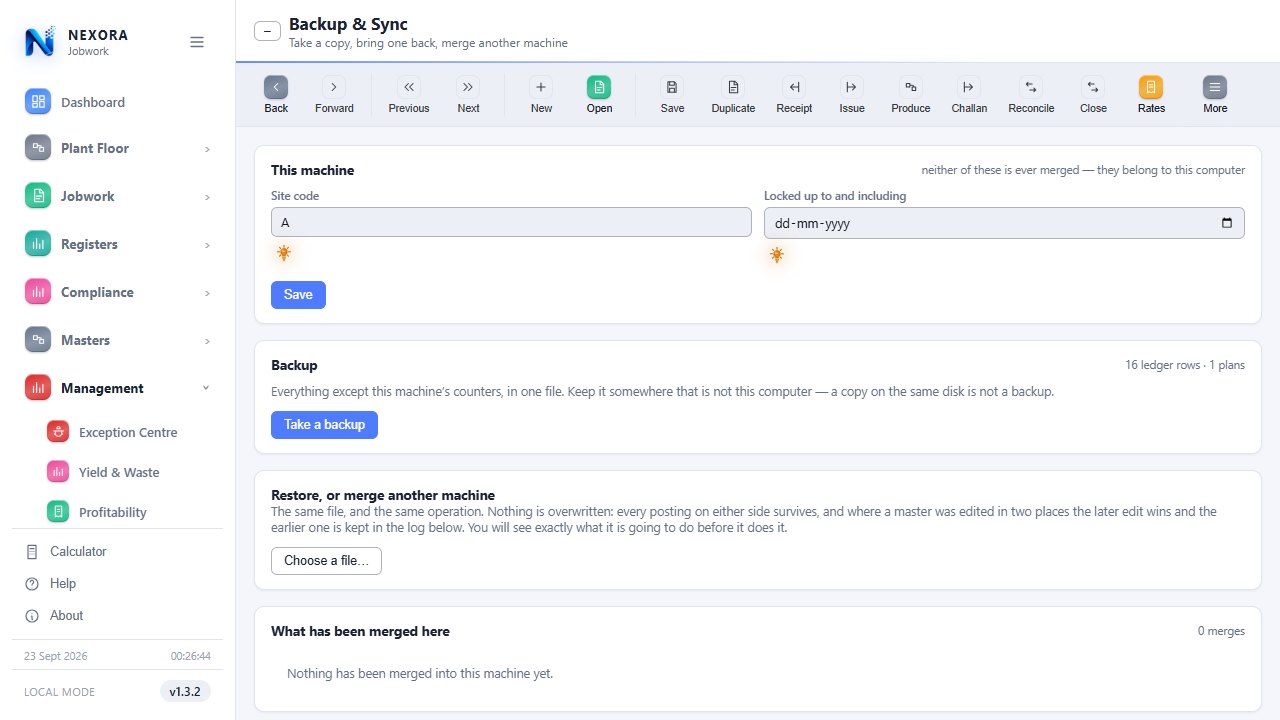
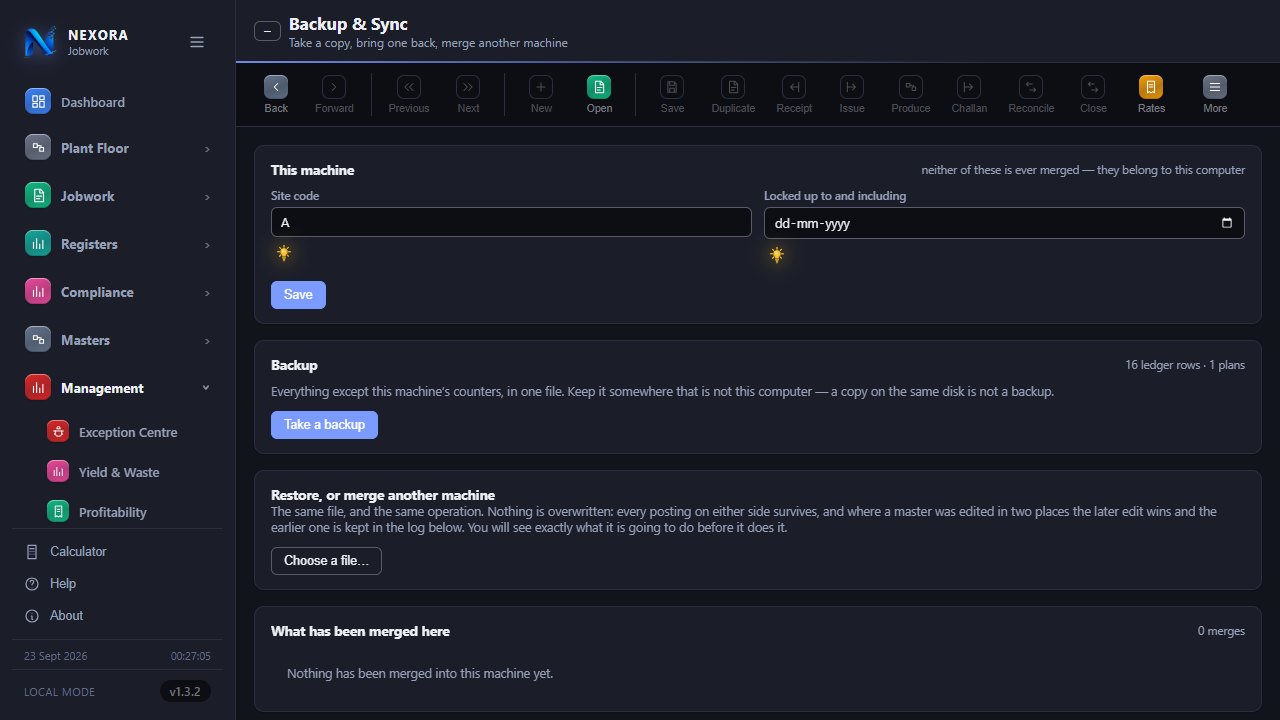
Each machine carries a site code that goes inside its document numbers, so two machines working with no connection between them cannot allocate the same number. Merging is checked before it is applied: every posting from both machines, present exactly once.
A plan whose kilograms do not add up, or a challan you are not sure is still within the year. We will show you what this software would have said at the time.