

An ERP a packaging MSME can actually run
Lead to payment on one set of records: sales and purchase, production orders through every process, batch-wise stock in warehouses with quality checks, GST with e-invoice and e-way bill, TDS, and accounts plain enough to keep yourself. It carries the parts people buy a big ERP for — and the bag weight, BOM and costing that no general ERP has ever had.
The parts a plant buys a tier-one ERP for — without the project
A small packaging plant that looks at a tier-one ERP meets the same three walls: the licence, the consultant, and the six months before anything works. What it actually wanted was a handful of things that ERP does well. Those are built here, by name, and they work on the first afternoon.
What a big ERP does, and so does this
- Relationship Map — every document that led to this one and every one that came after, drawn, with the batches and the prices on it
- Base and target documents — Copy from / Copy to on every window: many purchase orders into one GRPO, many sales orders into one challan and one invoice
- Drafts, last prices and the credit limit, special prices per customer, and the dunning letter when a bill runs late
- Inventory status, inventory audit and the posting list; batch traceability forward and backward from any batch
- Form Settings in every window — each person decides their own columns and extra fields, and keeps them
- Approvals by amount, two levels deep, with nothing made from a document until it clears
- MRP across every BOM level with lead times, raising purchase requests and production orders from what you tick
- Short transaction codes — Nexora's own, or the ones your people may already have in their fingers from another ERP, or both; the administrator chooses
And what it does that they do not
- The bag is calculated, not typed. Construction, GSM, component weights, raw material with waste and the costed BOM come from Nexora Sales & Costing's own engine, inside the ERP
- Batches that know what they are — denier, GPM, GSM, micron on the batch, its label and the packing slip, by item group; up to a thousand at a time, or pasted from Excel
- Nexora AI in ગુજરાતી, हिन्दी and English — it answers from your records, fills a window and shows you first, writes a report you keep, and makes a rule from a sentence
- It keeps working when the line is down, and catches up by itself
- Your data where you want it — a computer in your own office, your own Supabase, or the Nexora cloud
- A Test company with a month already in it, so people learn on real-looking work and break nothing
- Rules in your own words. Say what must not happen; it is written as a check, tried against your last documents, and kept by every computer
- No consultant between you and a change. Series, print designs, fields, roles and dashboards are settings, not a project
Said plainly: Nexora ERP is not a copy of anybody else's software and does not pretend to be one. It takes the functions of that class which earn their place on a packaging floor, builds them the Nexora way, and leaves out the rest. Where a plant genuinely needs what only a tier-one ERP provides — many legal entities, many countries, consolidated group books — we will say so rather than sell you this.
One window per job, and a dashboard for every module
Party on the left, number and dates on the right, items, then the remark and the amounts. Learn one document and you have learnt all of them. The action bar never moves — Back, New, Edit, Save, Print, Excel, Chat, Notes, Sheets — and every table copies, goes to Excel and prints.
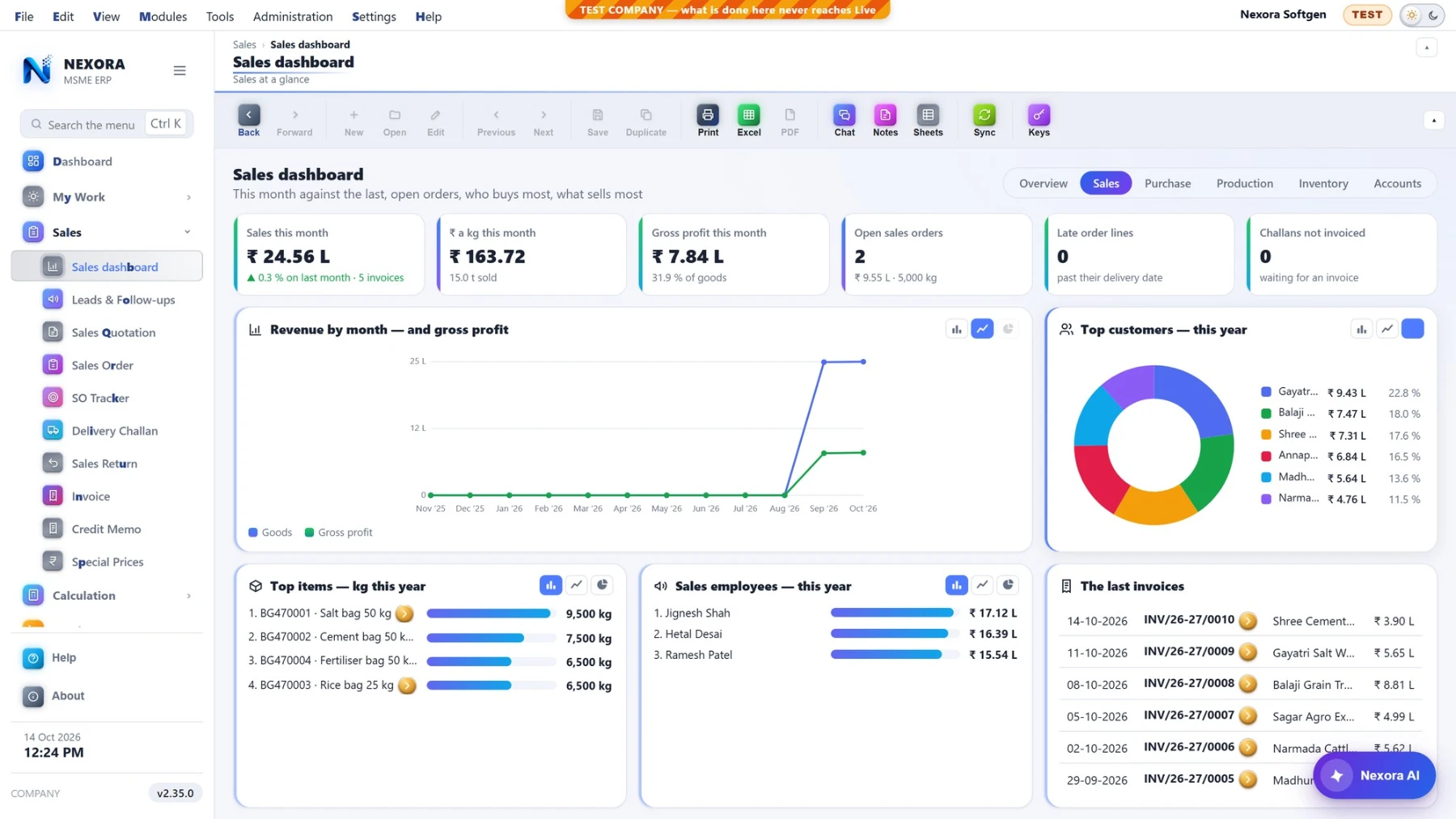
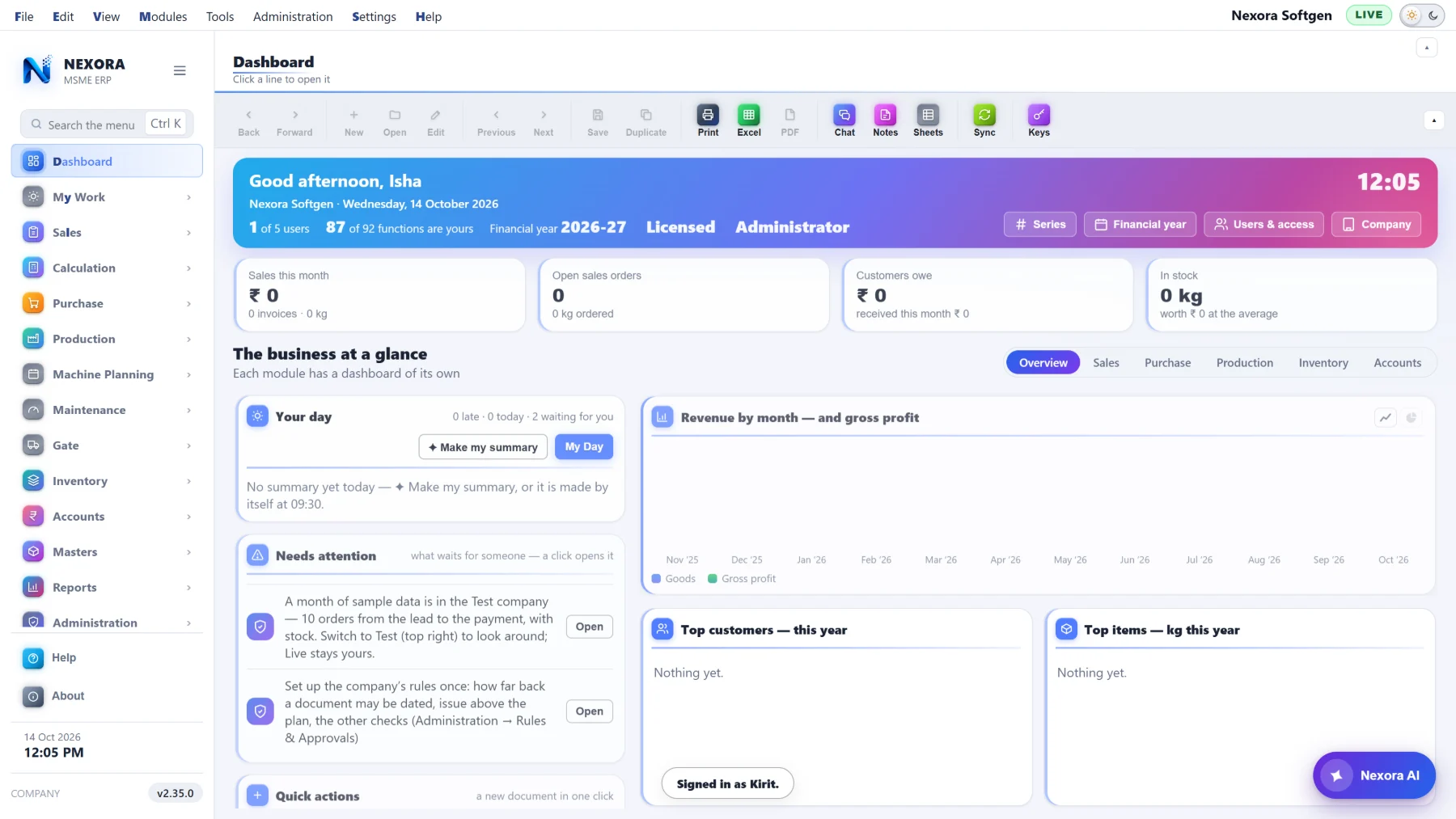
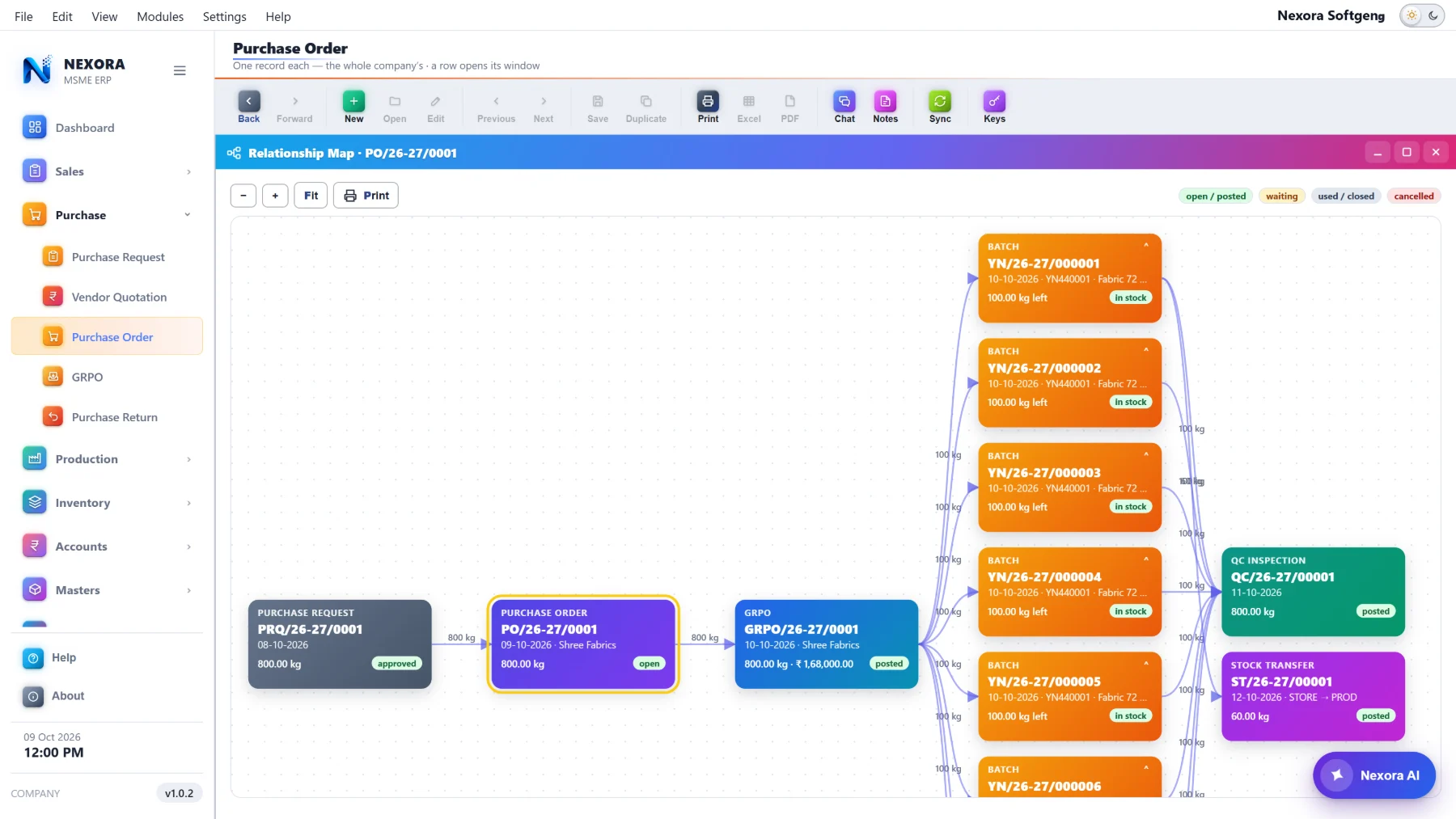
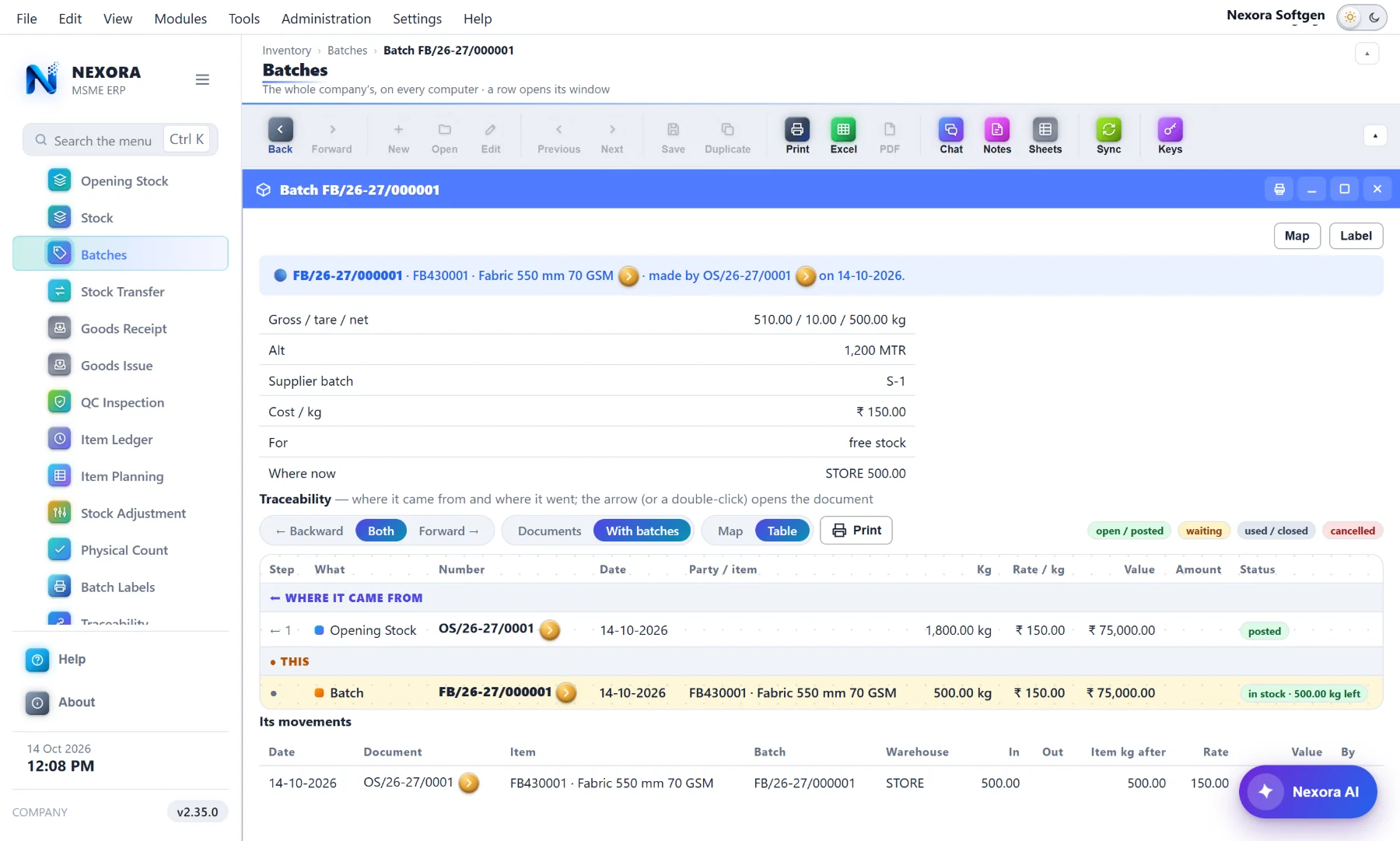
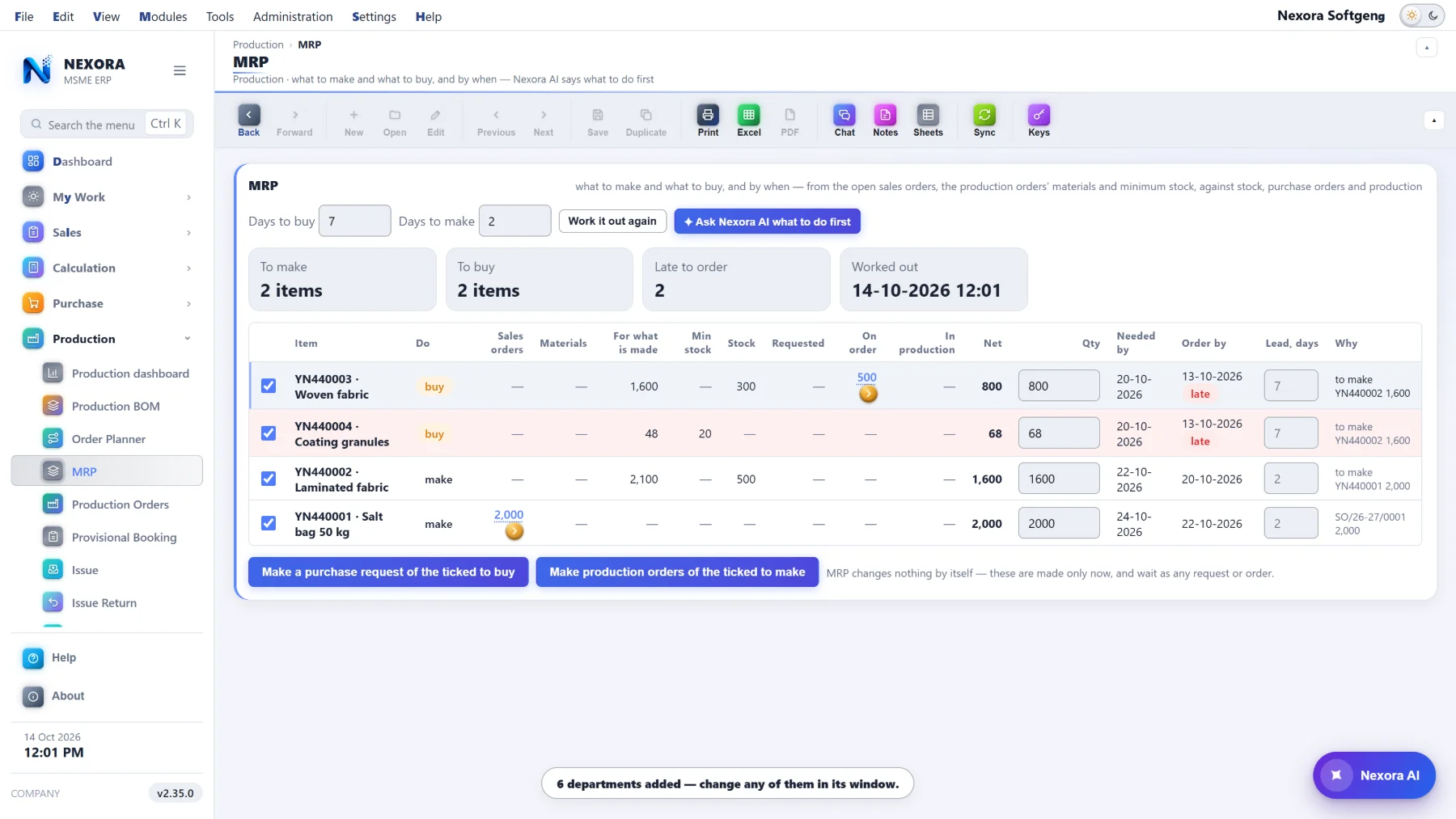
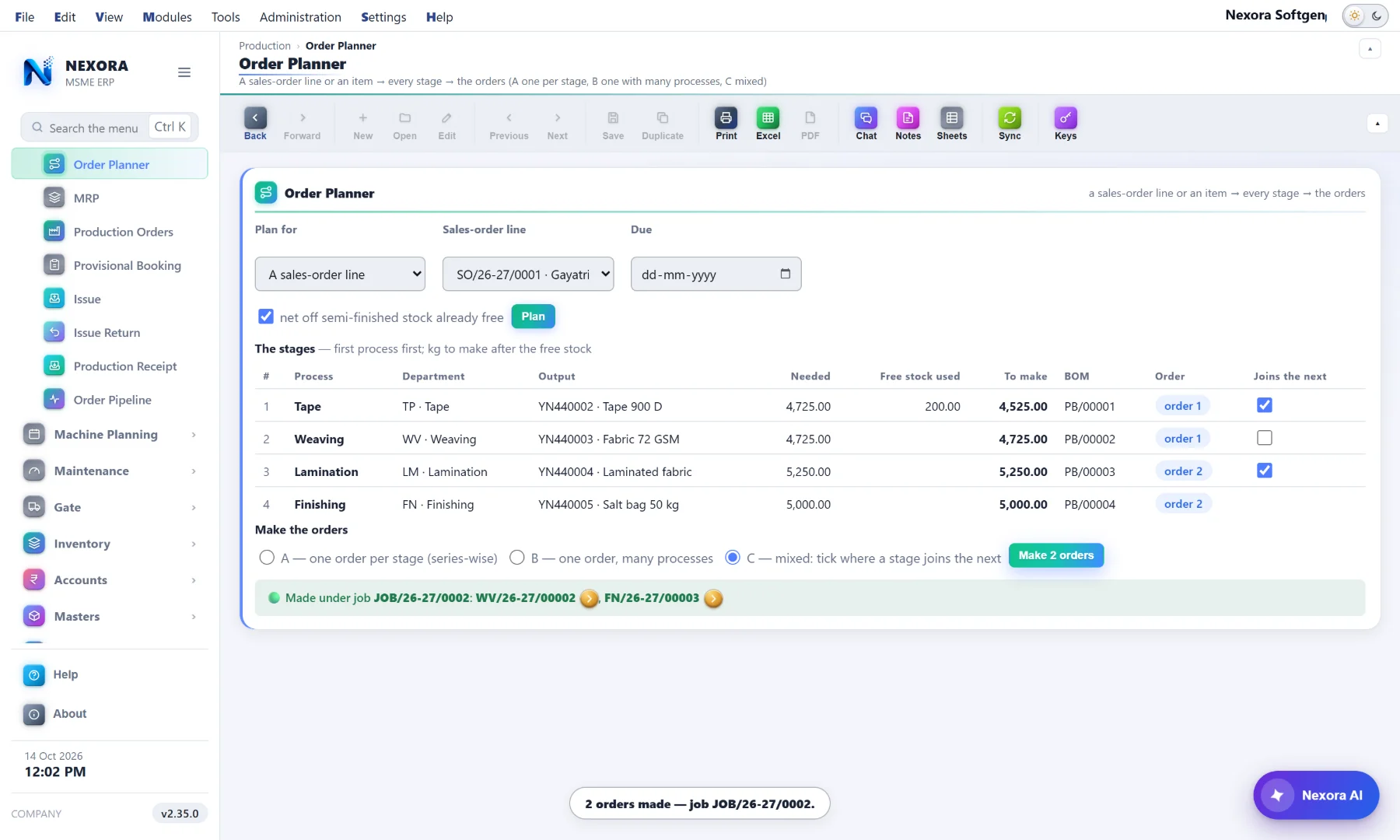
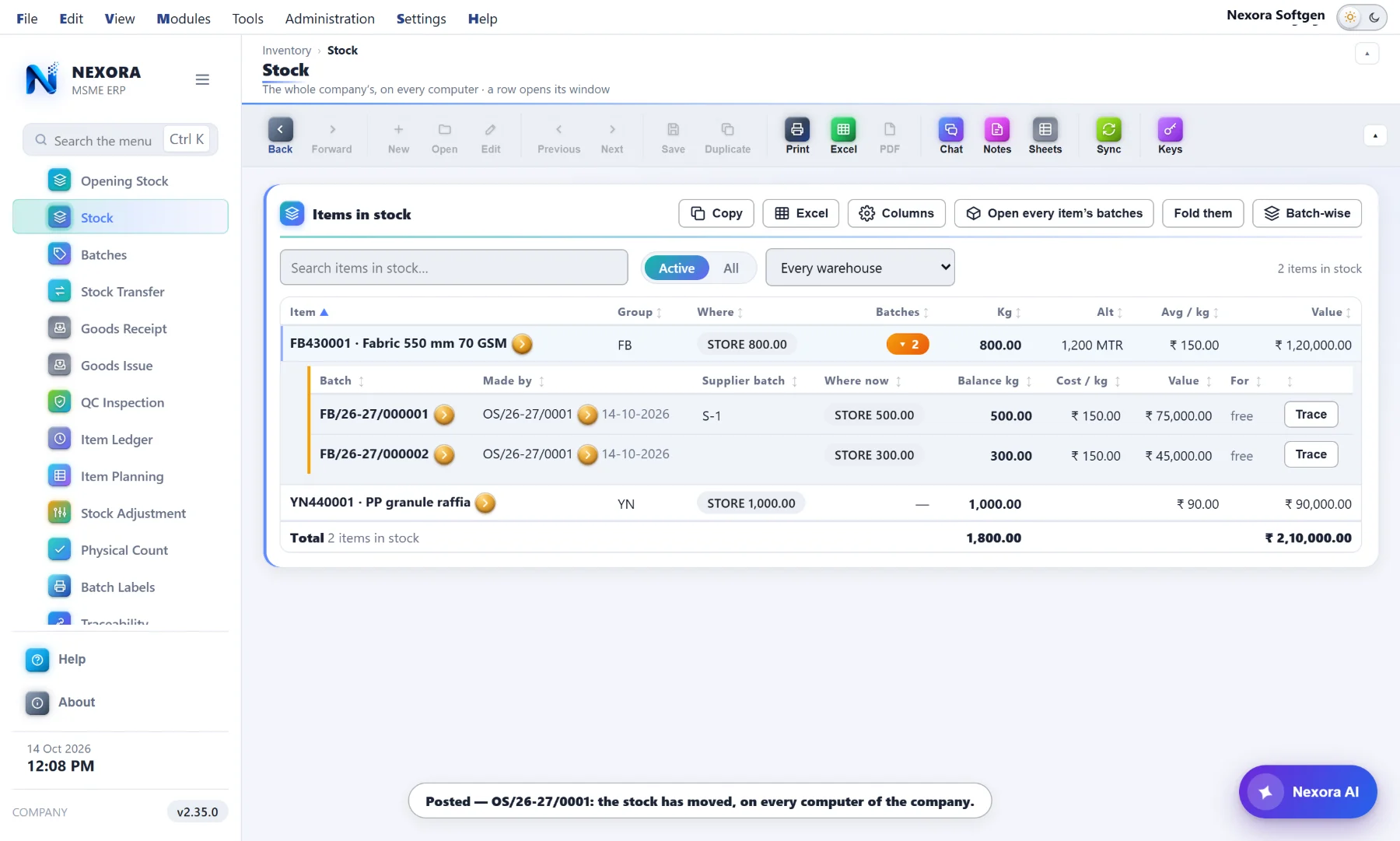
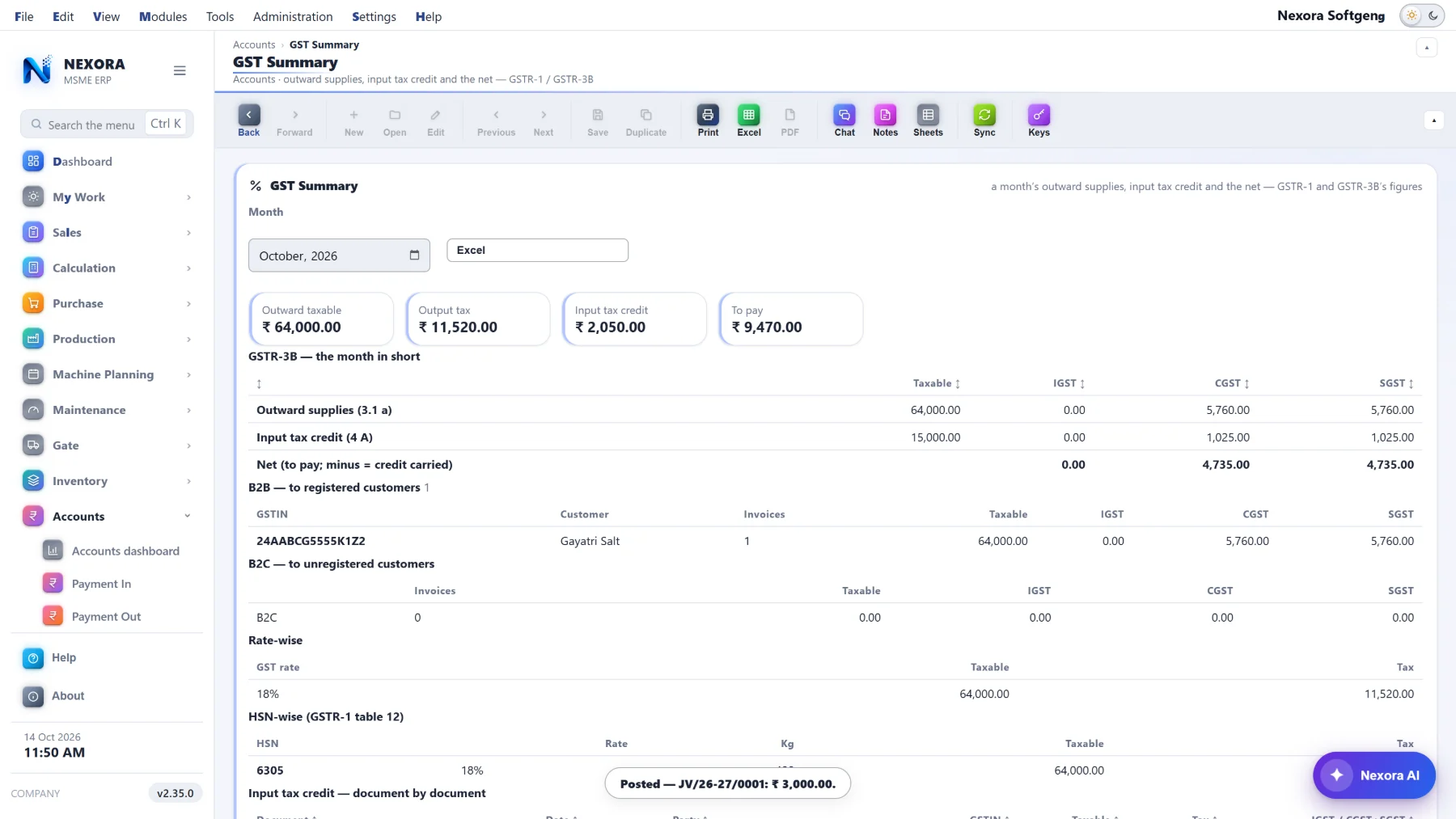
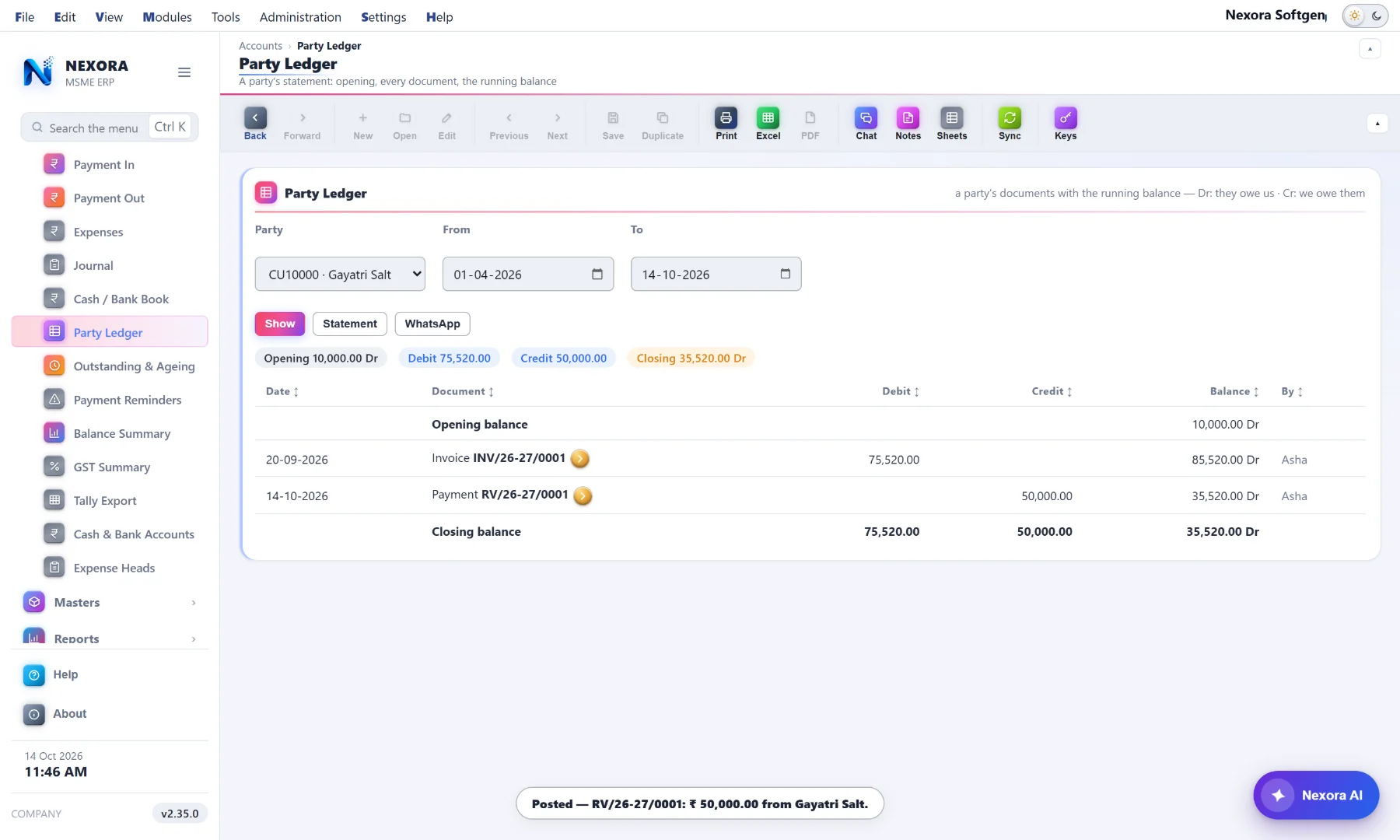
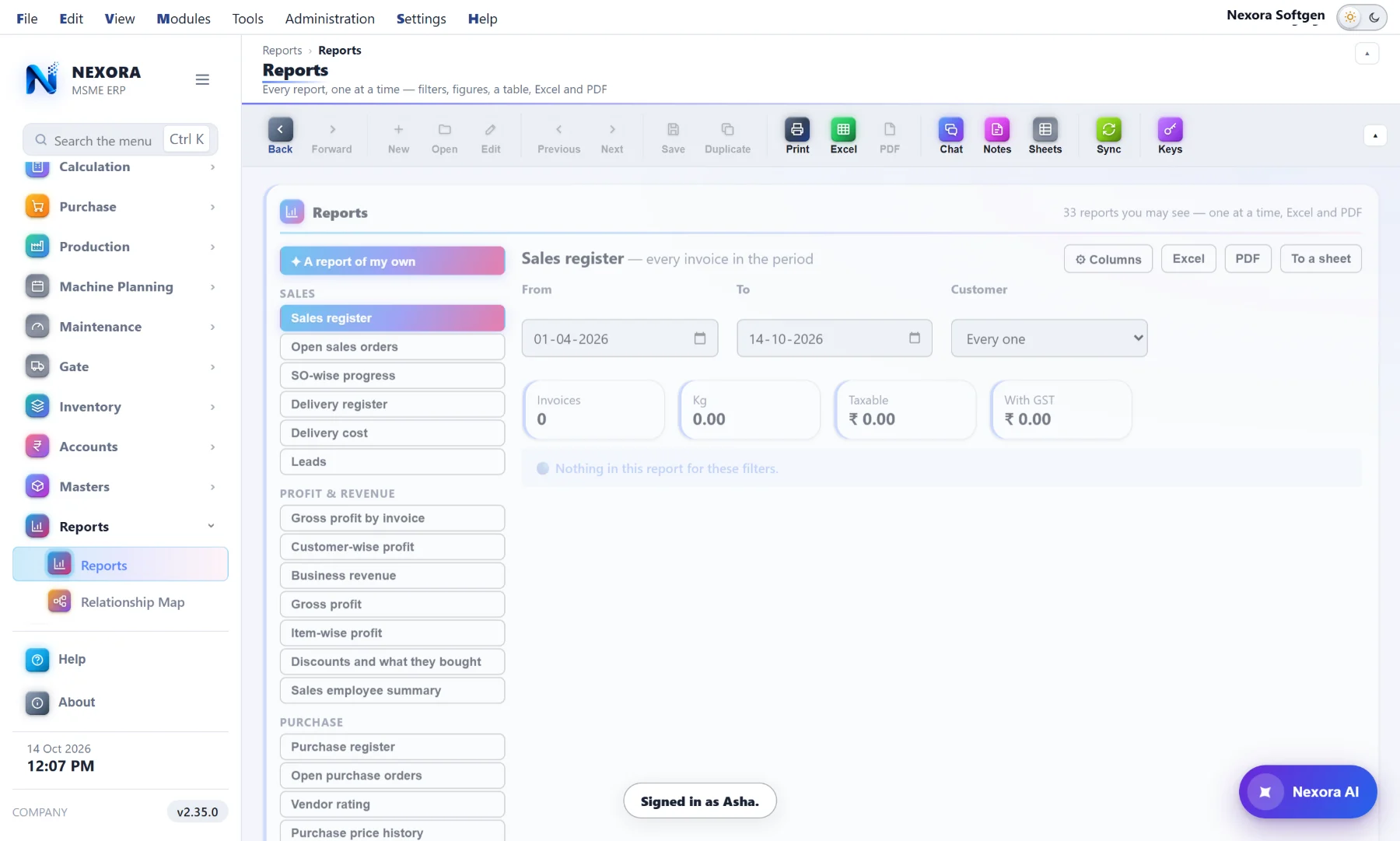
From the lead to the money in the bank
Every module shares the same items, parties, batches, warehouses, processes and people. Switch off the ones you do not want — calculation, marketing, machine planning, maintenance, MRP are optional per company, and nothing else changes.
Material that is not yours, and material that is not here
A packaging plant does jobwork both ways — it takes a customer’s granule and gives back bags, and it sends its own fabric out to be laminated or printed. Both are the same trap: stock on your floor that you do not own, and stock you own that is on somebody else’s floor. Nexora ERP keeps each in its own place, and the GST clock on both.
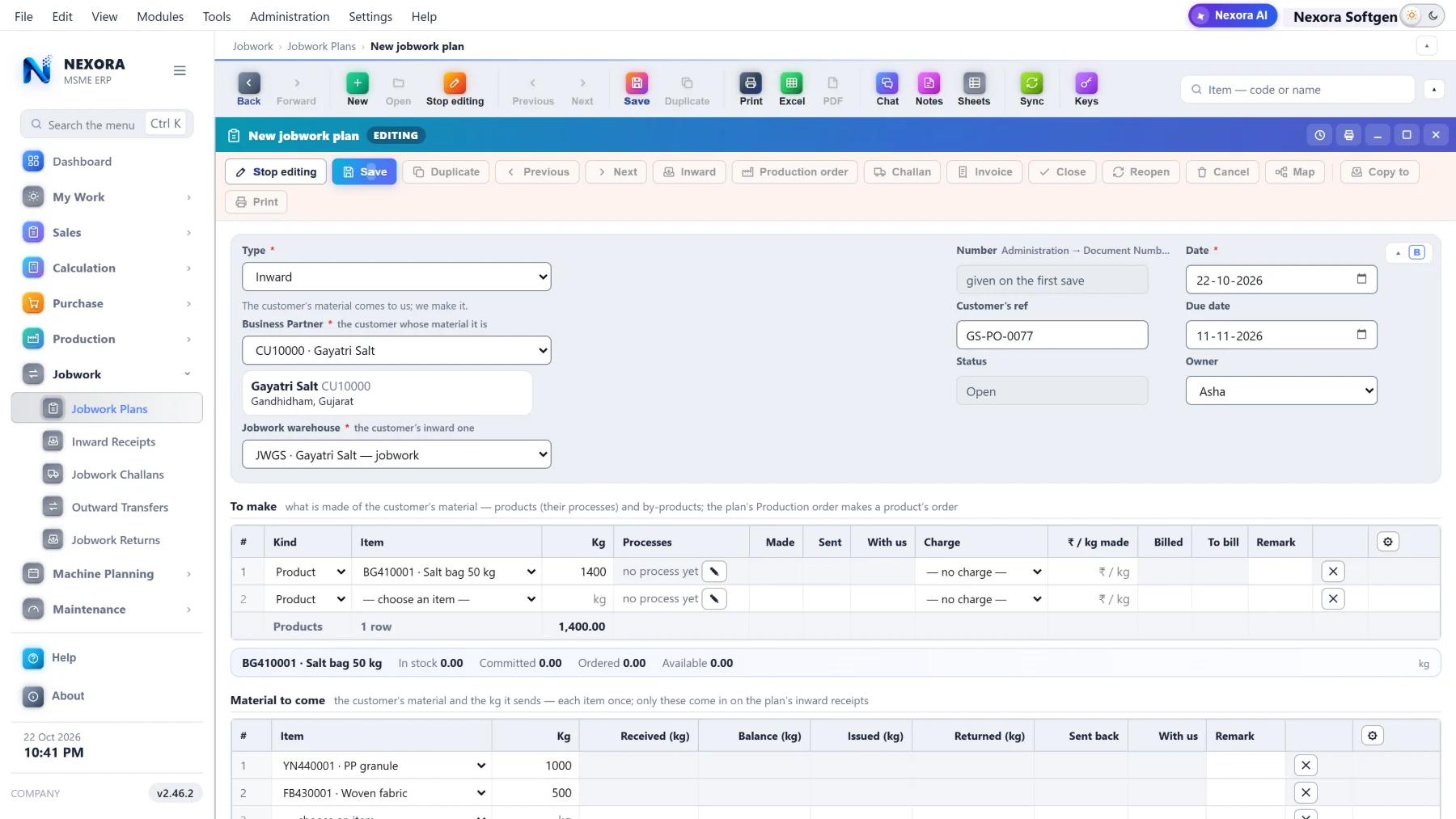
Inward — you do the work
A jobwork plan holds the customer, the material coming in and what is to be made of it. The inward receipt takes that material into a jobwork warehouse of that customer’s — and the ERP is careful about what that means:
- It is not your stock. Not in Available, not in MRP, not in Item Planning, not in the short list — because it is not yours to plan with
- A production order from the plan, with the issue held to that plan’s own material and batches
- What goes back rides a jobwork challan, with its print and its e-way bill as job-work returns
- Your charges are a service item, billed from the plan on a service invoice, kilogram by kilogram
- The plan always shows Received · Issued · Returned · Made · Sent back · With us
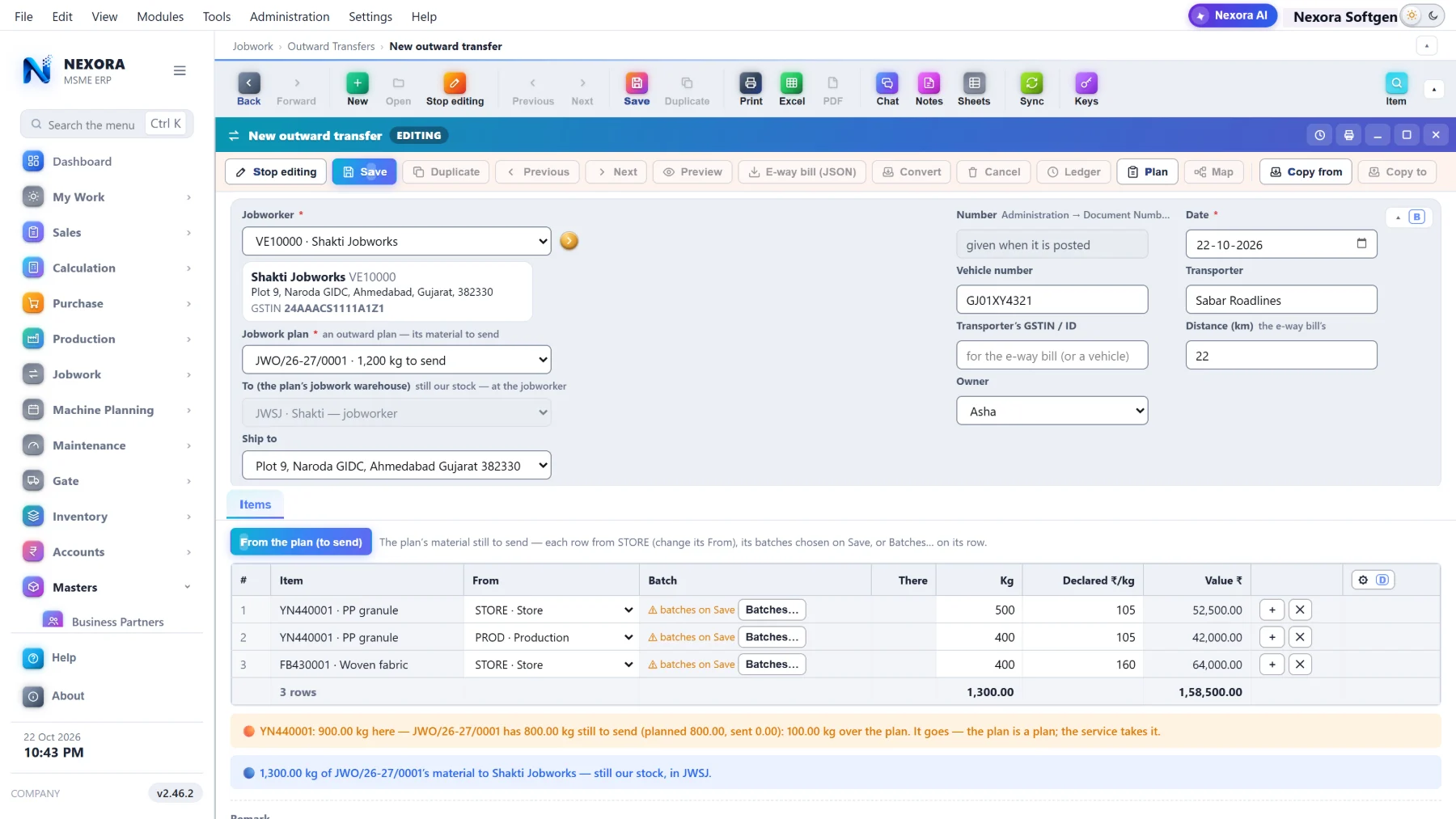
Outward — somebody else does it
An outward transfer sends your material to the jobworker’s warehouse, with its delivery challan and its e-way bill as job work. It stays yours, and the ERP keeps counting.
- One click when it comes back — Convert turns the return into its receipt, against the transfer it went out on
- Never more back than went: each transfer remembers exactly what it sent, item by item
- The jobworker’s bill is an AP invoice made from the plan, so his charge lands on the right material
- Sent · Balance to send · At the jobworker, on the plan and on his own card
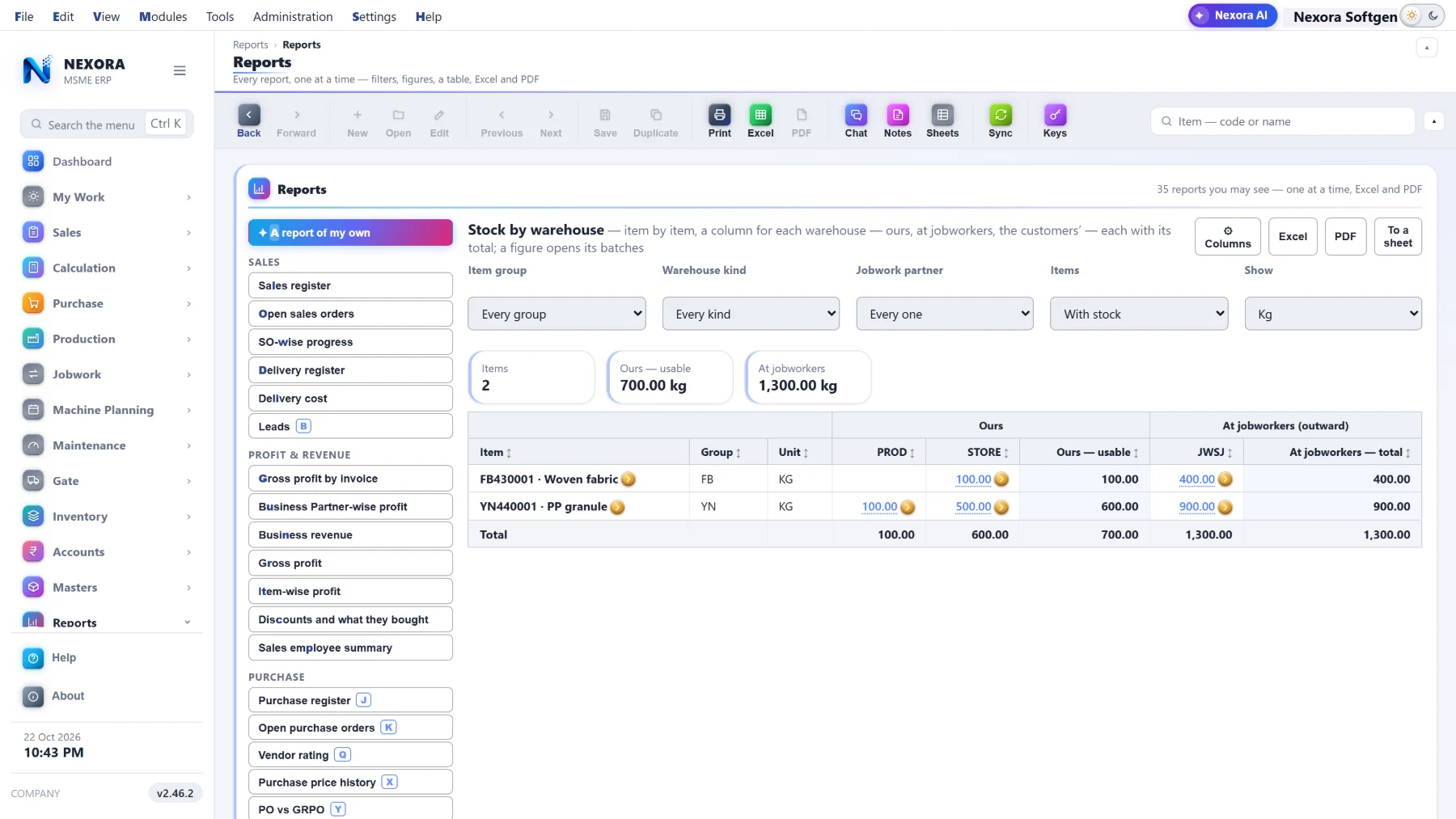
And the question GST will ask: how long has it been there?
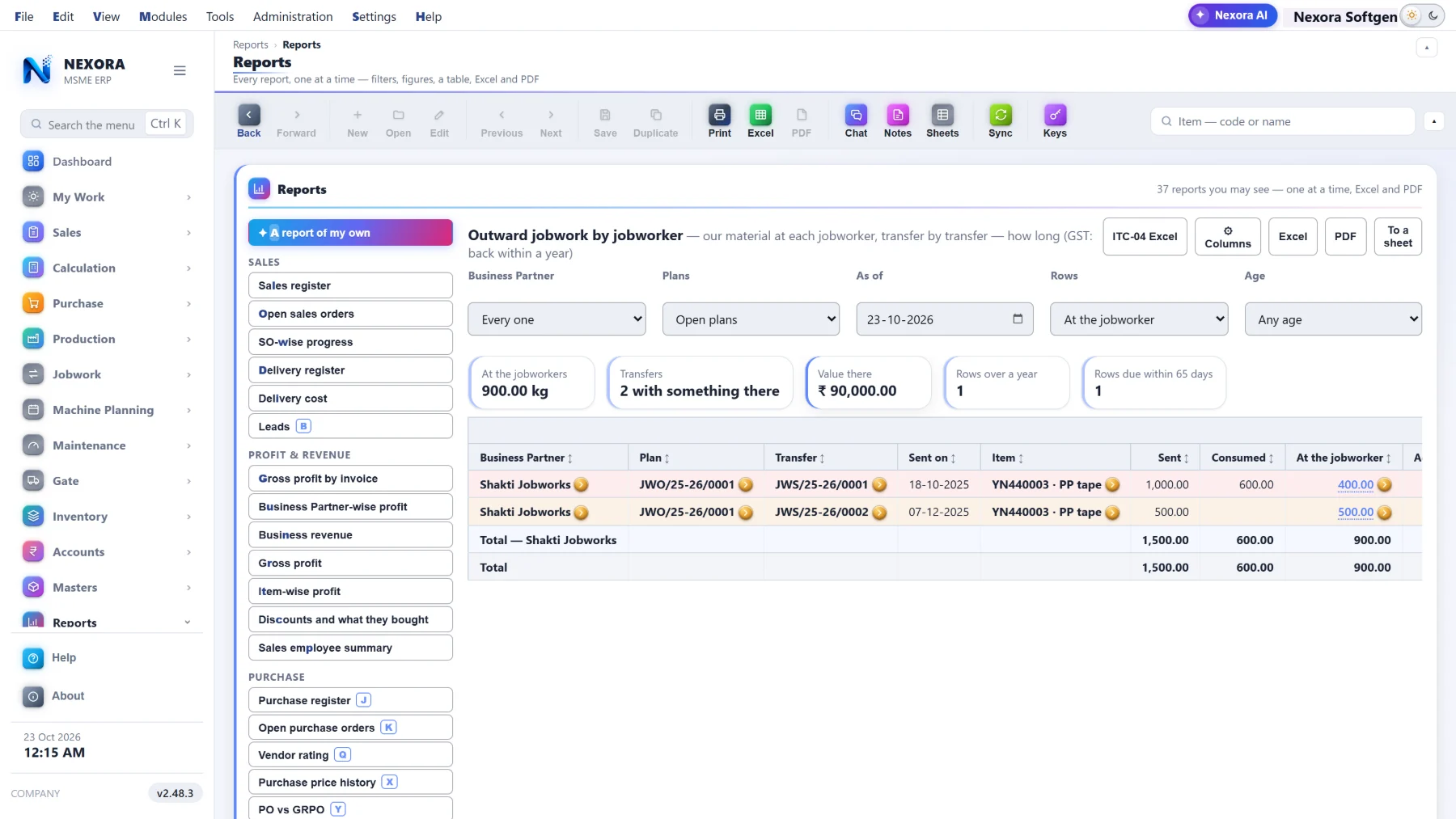
Material sent for job work has to come back within a year. The reports are built around that — by Business Partner, as of any date you pick.
By customer, inward
Customer → plan → item: received, issued, returned, made, sent back and with us — with the oldest receipt still sitting here.
By jobworker, outward
Sent, consumed, at the jobworker, how old it is and the date it must be back by. Anything over a year stands out.
It warns you itself
Needs attention speaks up when a transfer has been out 300 days or more, while there is still time. Or ask Nexora AI “which jobworker has our material for more than six months?” and it opens the report at that age.
The returns, before they are late
GST is not a report you build at the end of the month — it is the shape the documents are already in. The summary lays out outward supplies, input tax credit and the net as GSTR-1 and GSTR-3B want them, with B2B and HSN beside it, and the Tally export for the accountant who wants it their way.
E-invoice and the e-way bill follow the IRP's own format, with the arithmetic checked before anything is sent and the signed QR kept on the invoice. TDS works to the 2025 Act as it stands from April 2026 — the section table, the thresholds, the challan and the return.
Each of the three is a switch an administrator turns on. Off, it changes nothing and only reminds you.
Where your data lives is your decision
A computer in your own office can hold the company's data, with the other computers finding it over the office network and backups taken at a time you pick. Or point it at your own Supabase project. Or let it sit in the Nexora cloud and think about none of it.
The licence is checked by Nexora's service on every route, and an administrator can download the company's whole data in one file whenever they like. Nothing about your plant is held hostage.
Nexora AI and your figures: a question goes out with your customers, items and people turned into codes. Your computer runs the search on your own records. Quantities, rates and costs are never sent.
Frequently asked
Is Nexora ERP a replacement for a tier-one ERP?
For a packaging MSME, usually yes — and we would rather you knew where it is not. It carries the functions of that class which earn their place on this kind of floor: the Relationship Map, base and target documents, drafts, last prices and credit limits, inventory status and audit, batch traceability both ways, Form Settings per person, approvals by amount, MRP and transaction codes you may already type. It does not do many legal entities, many countries or consolidated group books. If that is what you need, a tier-one ERP is the honest answer and we will say so.
We already use Nexora Sales & Costing. Do we throw it away?
No — it is inside. The same calculation engine, the same BOM and the same costing run within the ERP, so a quotation you built there and an order you make here are talking about the same bag. Plants often start with Sales & Costing and add the ERP when the order book is the problem rather than the price.
How long before it is actually being used?
A new company registers, walks a set-up, and lands in a Test company that already holds a month of work — ten whole cycles from the lead to the payment, with stock and parties. People learn on that, break what they like, and nothing real is touched. Going live is a button, and Make Test again takes the sample away.
Does it need the internet?
No. It is a Windows application that keeps working when the line is down and catches up when it is back. What it does need is a decision about where the company's data lives — a computer in your own office, your own Supabase project, or the Nexora cloud.
Can it handle our batch numbers and roll weights?
That is what it was built around. A document line's quantity is made up of its batches — up to a thousand at once, each the same, a total split, or a block pasted straight from Excel. Each batch carries the fields its item group needs (denier, GPM, GSM, micron and the rest), and those follow it onto its label and the packing slip.
What does Nexora AI do here, and what goes to Google?
It answers a question about your records in English, ગુજરાતી or हिन्दी; fills a window from what you said and shows you before saving; plans an order or an MRP run; writes a report you keep and share; turns a sentence into a company rule; and summarises a workbook with a graph. What leaves your computer is the question with customers, items and people replaced by codes. Quantities, rates, costs and balances are never sent.
Is GST, e-invoice and TDS actually built in, or a export to someone else?
Built in. GST comes out in the shape GSTR-1 and GSTR-3B want, with B2B and HSN, and there is a Tally export for the accountant who prefers it. E-invoice and the e-way bill follow the IRP's own format with the arithmetic checked before sending and the signed QR kept on the invoice. TDS works to the 2025 Act as it stands from April 2026. All three are switches — off, they only remind you.
Who can see what?
Roles are the company's own. Every document has an owner, so a salesperson sees the orders given to them, and is told in the chat when one of theirs moves — a challan, an invoice, a production stage, an approval. Rights go down to a single dashboard. Purchase orders, sales orders and production orders above an amount wait for one or two levels of approval, and nothing is made from them until they clear.
Can we change things ourselves, or does it need you every time?
Series per module, print designs per series, the fields each person sees, roles, dashboards, the back-dating rule and the company's own checks are all settings. An administrator can even say a rule in plain words — "a GRPO must not exceed its purchase order" — and it is written as a check, tried against your last documents, and kept by every computer. We would rather not be in the middle of your Tuesday.
What happens to our data if we stop?
An administrator can download the company's whole data in one file at any time, and the Tally export and Excel are on every table and report. We hold no part of your plant to ransom.
Bring your own month and we will run it
Show us one order from the enquiry to the payment — the way your plant really does it — and we will walk it through Nexora ERP in front of you.